
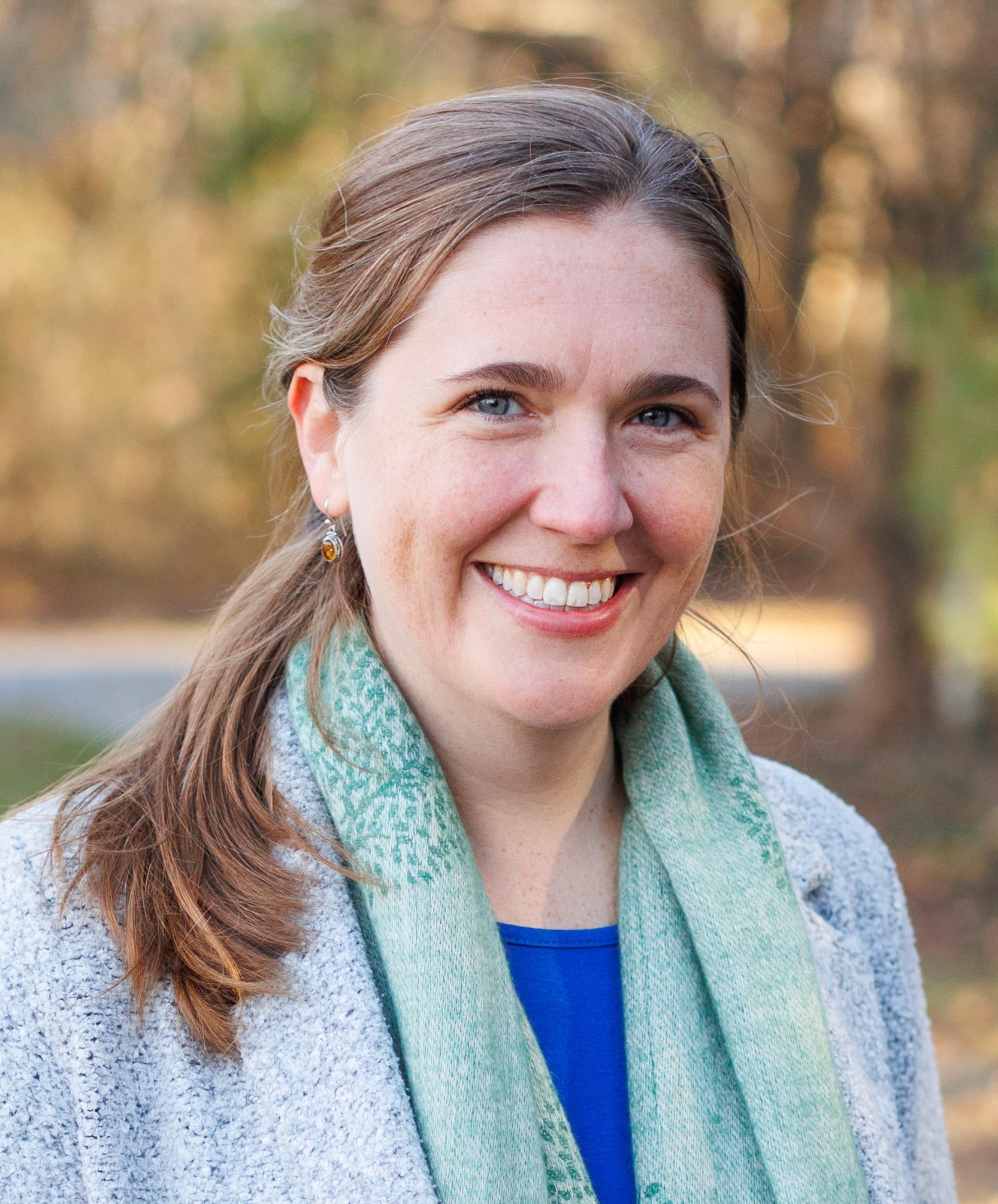
Congratulations to Dr. Murton on her appointment as co-editor of The Chaucer Review
Associate Professor of English Megan Murton has been appointed as one of two co-editors of the leading scholarly journal The Chaucer Review. She and co-editor Leah Schwebel have been featured in a Meet the Editors Q&A.
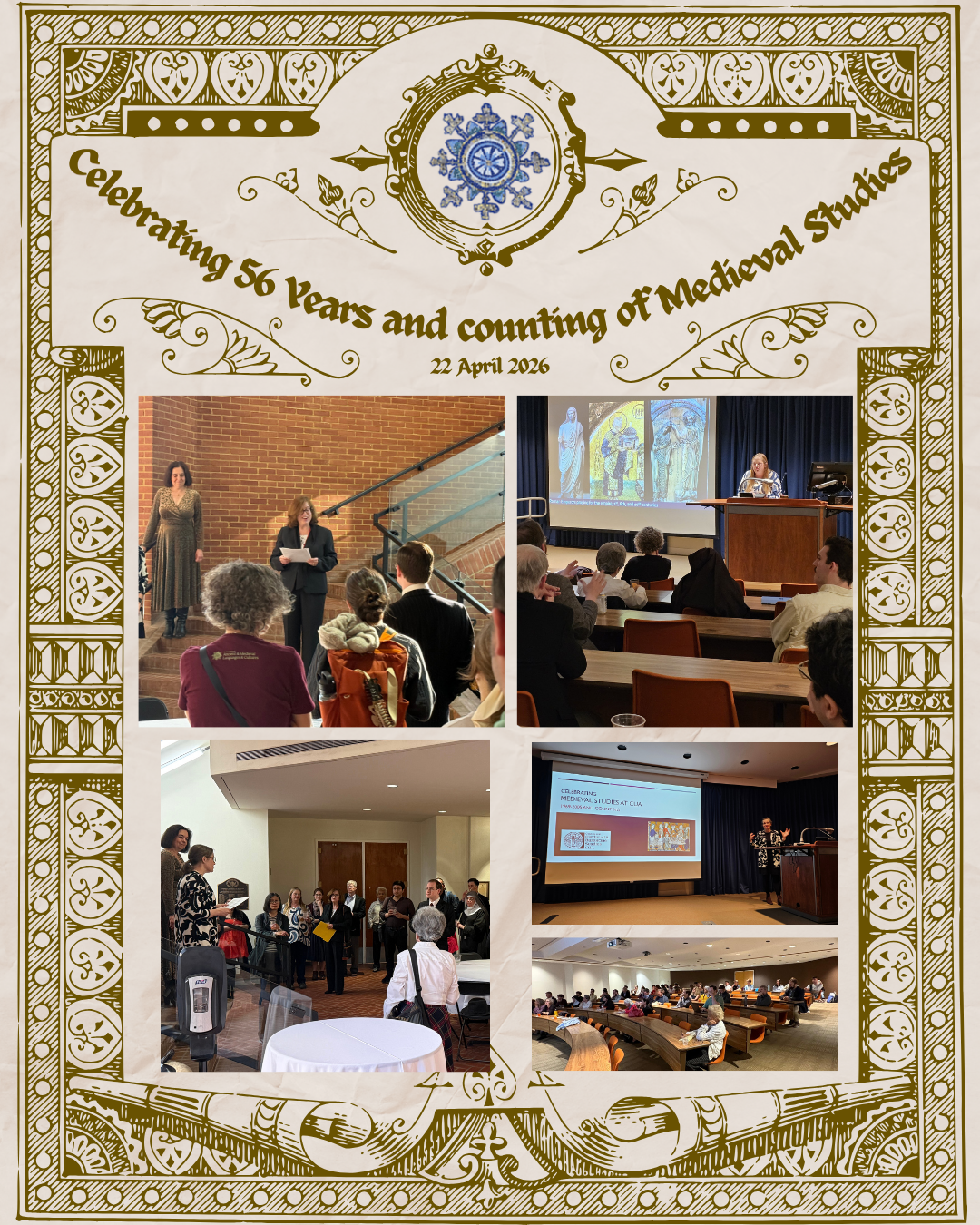
Celebrating fifty plus years of Medieval Studies at CUA
CUA's program in Medieval Studies was first established in 1969 and later turned into the renowned Center for Medieval and Byzantine Studies (MBS for short) that fostered scholarly collaborations and friendships, staged many memorable events, and raised a talented cohort of young scholars over the decades. In July 2025, the Center transitioned its activities into the new (and very successful and energetic) Dept. of Ancient and Medieval Languages and Cultures (or A&M)—becoming the proud M of A&M.
To celebrate the long history of our field and to mark a new beginning, on Wednesday, April 22, in Aquinas Hall Auditorium faculty, colleagues, students, alumni, and well-wishers celebrated over half a century of Medieval and Byzantine Studies at the Catholic University of America.
Professor Leonora Neville (former colleague in MBS, now at the University of Wisconsin Madison, and Senior Fellow of Dumbarton Oaks) delivered a fascinating lecture entitled "God and Good Government: Civic Religion in the East Roman Empire, ca. 843-1180" to mark the achievement.
Happy retirement, Professor Cook!
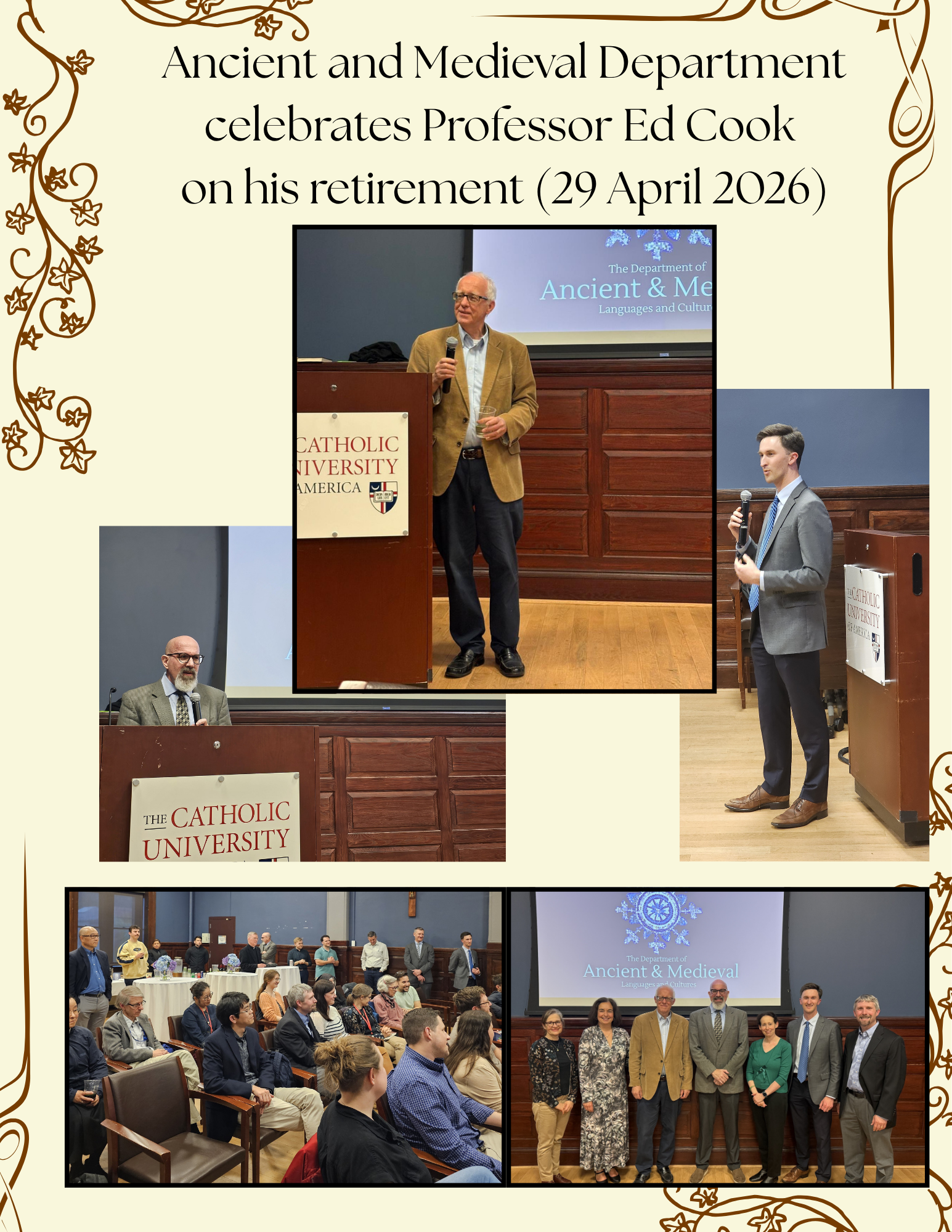
On April 29 2026 nearly forty colleagues, friends, current faculty, former faculty, former students, and current students gathered to celebrate the retirement of Professor Ed Cook, Ordinary Professor of Semitics. We wish Ed a rewarding retirement and many peaceful years of researching Aramaic.
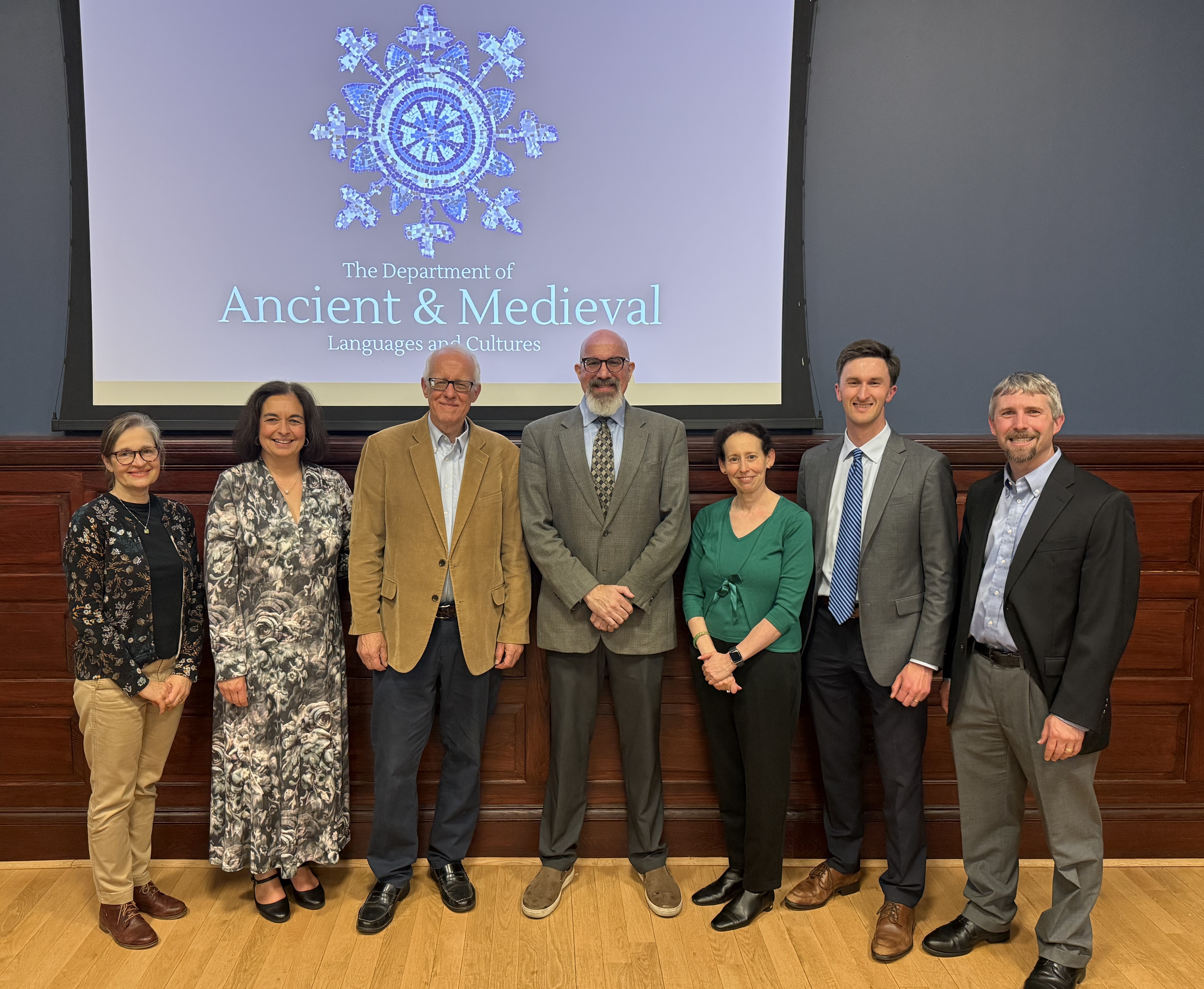
(Ancient and Medieval faculty, l-r: Dr. Lilla Kopár, Dr. Sarah Ferrario, Professor Ed Cook, Dr. Andrew Gross, Dr. Jennifer Davis, Dr. Nate Tilley, and ICOR fellow and one of Professor Cook's former students, Dr. Andrew Litke.)
Now on display in the Mullen Library - The Weiner Manuscript Collection
A Gift of Faith and Living Heritage
Some gifts take years to fully appreciate. Over the course of more than a decade, Gerald and Barbara Weiner quietly assembled and donated 953 Ethiopian manuscripts — Christian and Islamic — to the Institute of Christian Oriental Research (ICOR). The collection they built is now one of the most significant of its kind, and this spring it takes center stage in Mullen Library's May Gallery.
The manuscripts span the breadth of Ethiopian written culture. Visitors will encounter illuminated codices covering liturgical and monastic themes, psalters used in centuries of devotion, and rare Ethiopian scrolls.
Gerald Weiner passed away in 2025. This exhibit is, in many ways, a tribute to the vision he shared with his wife Barbara — a belief that cultural heritage belongs to everyone, and that preserving it is an act of faith in the future. The donation they made to ICOR will support research, education, and scholarship for generations to come.
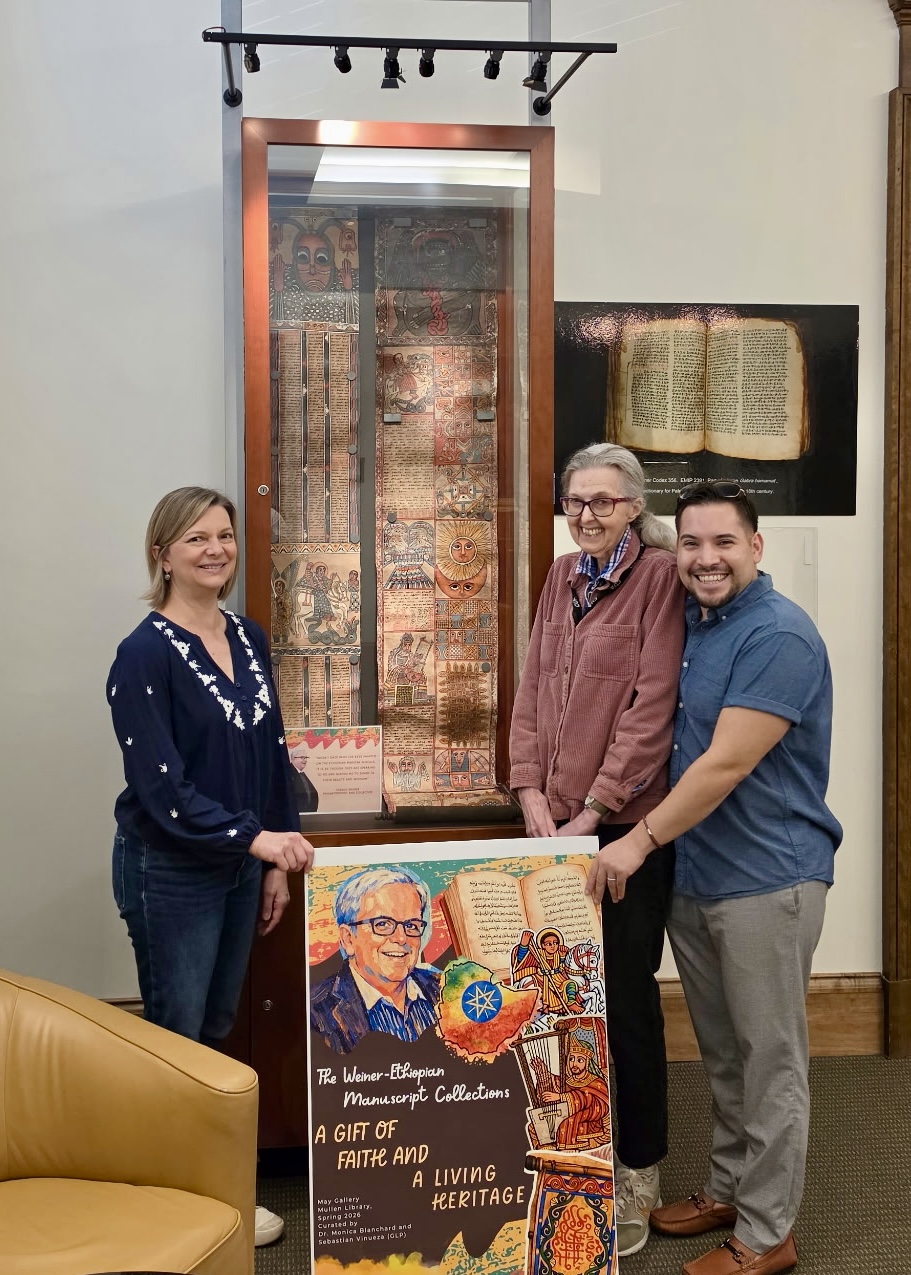
Curated by Dr. Monica Blanchard, Curator, Semitics/ICOR Library and Sebastian Vinueza (GLP) With the collaboration of Emily Brondos Strompf (MLIS Student)
Classical Civilization senior presents at University Research Day 2026
During University Research Day 2026, soon-to-graduate senior, Mr. Carl Caragine, presented his research on unexpected venues for exhibiting antiquities in a poster titled, The Ancient Dining Hall: Communal Dining at Ancient Caesarea Maritima.
The artefacts Mr. Caragine used to illustrate his poster came from a collection in the School of Theology and Religious Studies. Mr. Caragine is currently curating an exhibition for display in Garvey Hall later in the semester.
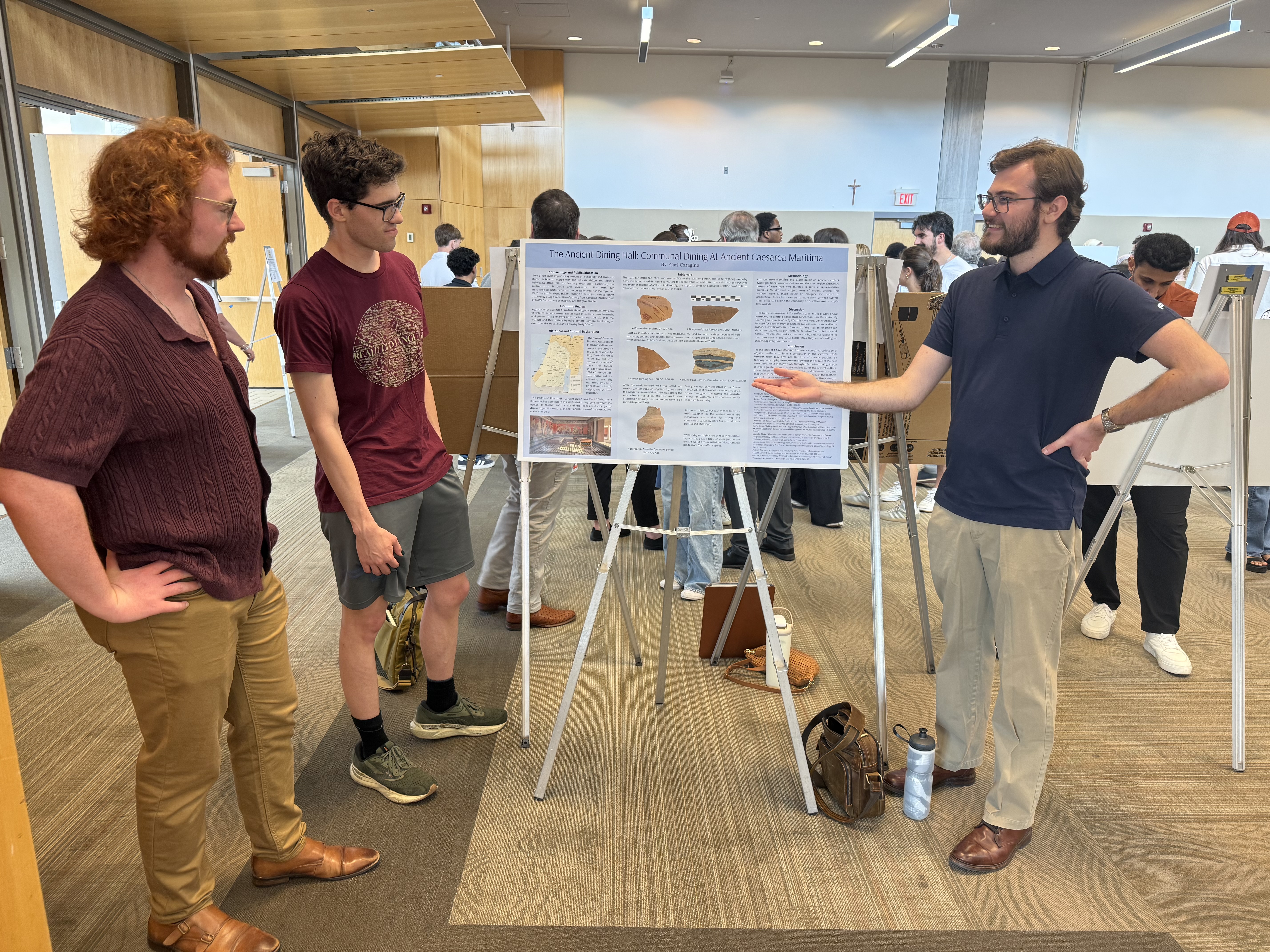
Mr. Carl Caragine presents his research to fellow Ancient and Medieval Department seniors Mr. Jack Riley and Mr. Nathaniel Erb.
Congratulations, Fr. Boby, now Ph.D!
On Thursday April 9 2026 Fr. Boby Varghese successfully defended his dissertation, "Jacob of Serugh's Homily on the Holy Eucharist: Critical Edition and Translation along with a Comparison with Ephrem's Eucharistic Exegesis."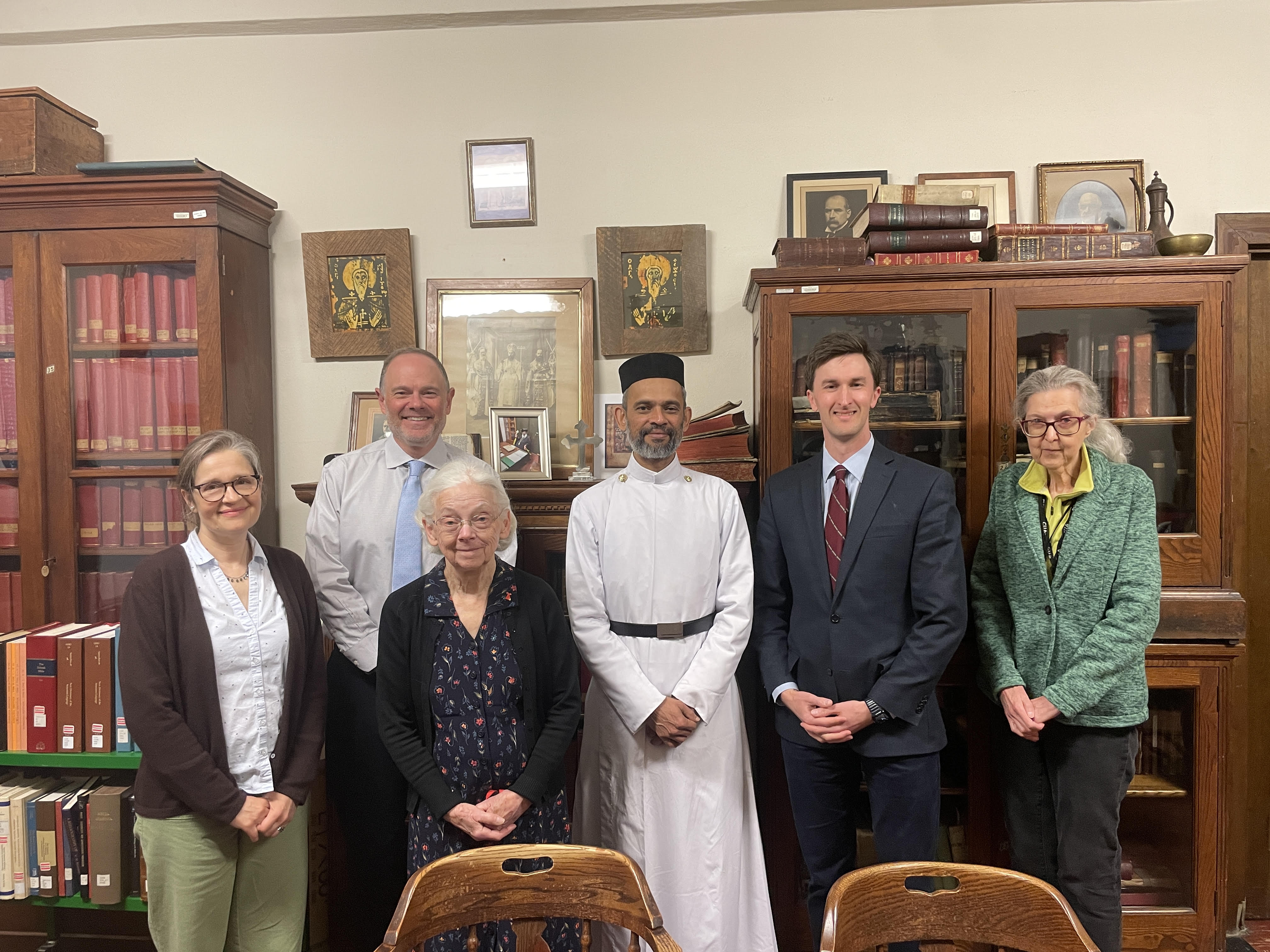
(l-r: Dr. Lilla Kopár, Dr. Brendan Rich, Dr. Janet Timbie, Fr. Boby Varghese, Dr. Nathan Tilley (director), and Dr. Monica Blanchard)
See you at Commencement, Fr. Boby!
Ph.D student Joseph Turco receives prestigious scholarship
The Classical Association of the Atlantic States (CAAS) awarded Mr. Joseph Turco (Greek & Latin - PhD) the coveted Hahn Scholarship for his forthcoming study at the summer session of the American School of Classical Studies at Athens (ASCSA). The Hahn Scholarship, awarded to just two students per year, honors E. Adelaide Hahn (1893-1967) PhD, Columbia (1929); classicist, philologist, linguist; impressive scholar of Vergil and Latin linguistics; respected professor of classics and administrator at Hunter in Manhattan (1921-1963).
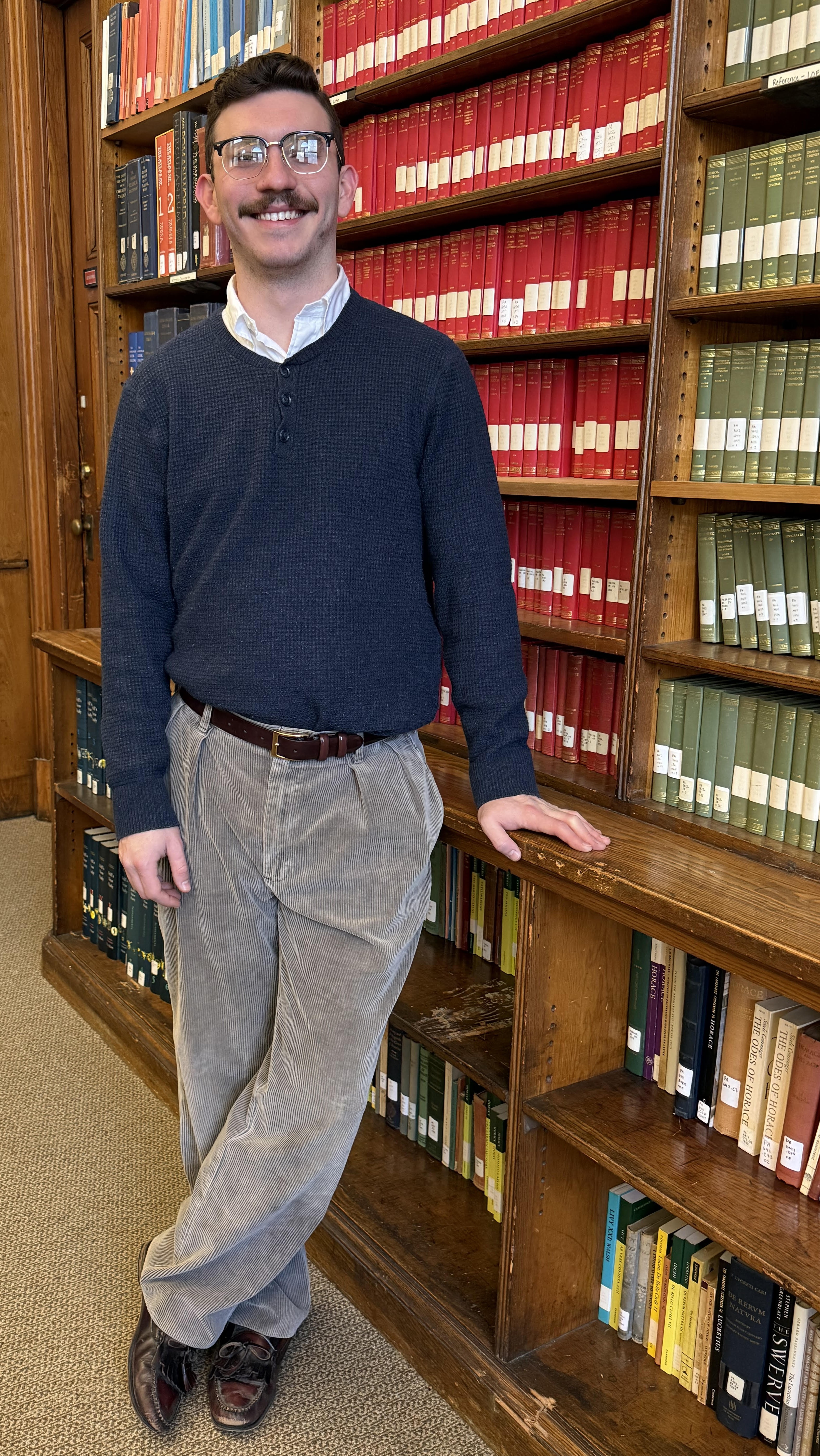
Father Innocent Smith (University of Notre Dame) to give 2026 St. Gregory Institute Lecture and seminar
This year's St. Gregory Lecture, St. Juliana of Cornillon, St. Thomas Aquinas, and the Liturgy of Corpus Christi, will be given by Father Innocent Smith (University of Notre Dame).
Fr. Innocent has provided the following abstract for his talk:
Although they likely never met in this life, St. Juliana of Cornillon and St. Thomas Aquinas were deeply united in their work to promote the feast of Corpus Christi. Juliana worked tirelessly to implement the new feast, helping to compose a liturgical office and winning the support of Archdeacon Jacques Pantaleon for her cause. Shortly after Juliana's death, Jacques was elected Pope Urban IV, and quickly entrusted Thomas Aquinas with the composition of a new liturgical office for Corpus Christi. In this presentation, I will tell the remarkable story of Juliana and Thomas's contributions to the feast of Corpus Christi, examining the influence of their respective liturgical texts for the feast in the thirteenth century and beyond.
The lecture will start at 5pm on Thursday 9th April in the McGivney Auditorium, on the campus of the Catholic University of America.
A catered reception will follow the lecture. Please RSVP via the following link: https://forms.gle/pJGDk2uRC9cNXq5ZA
This event is free and open to the public. To request mobility accommodations, please email [email protected].
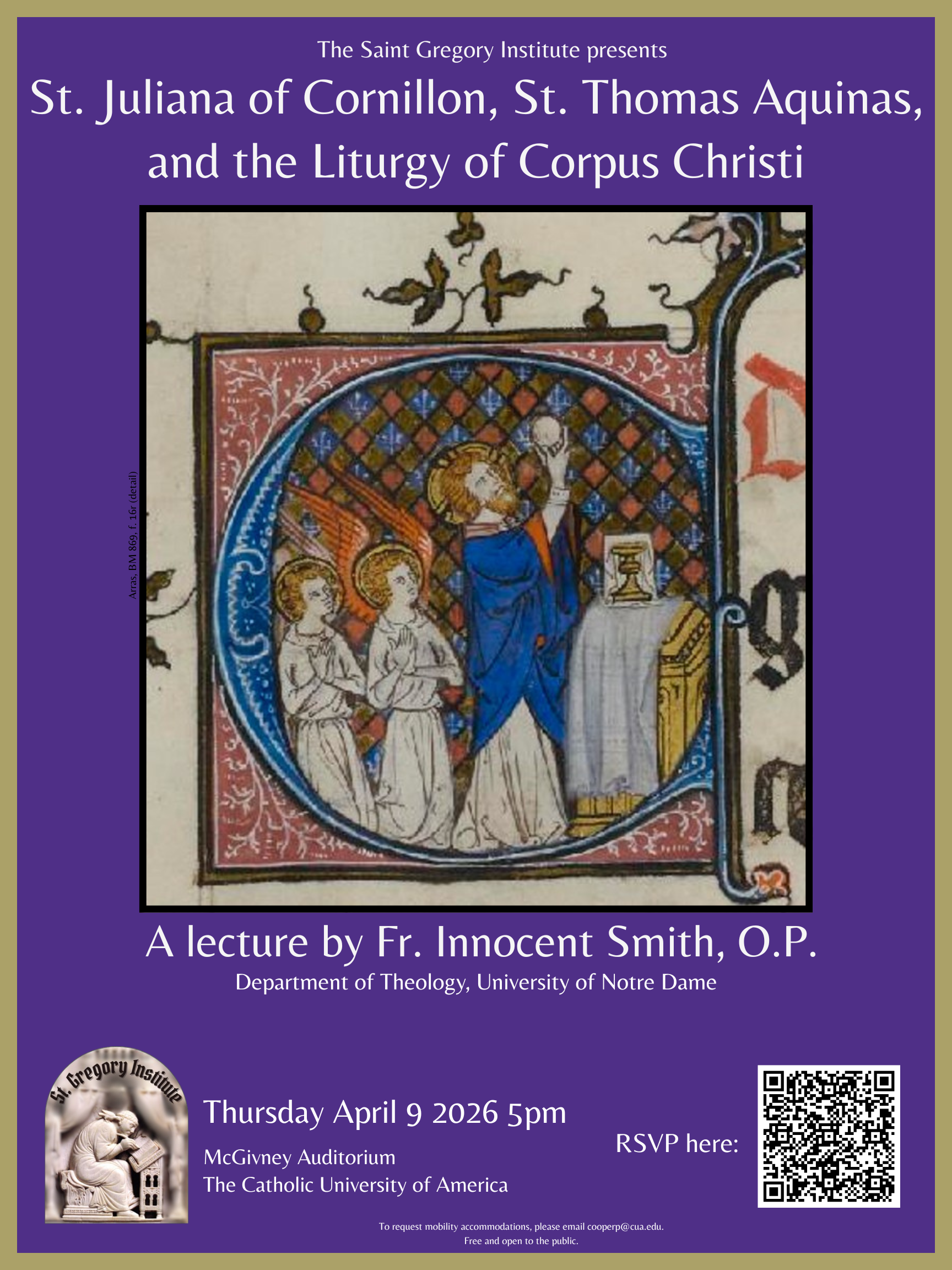
The next day at 3:30, Fr. Innocent will lead a seminar entitled Biblical Typology and Eucharistic Theology in the Corpus Christi Office of St. Thomas Aquinas
Abstract: Writing in the early 14th century, the Dominican friar Ptolemy of Lucca emphasized the remarkable breadth of scriptural imagery contained in Thomas Aquinas' liturgy for Corpus Christi: "If we attend to the words of the writer, almost all the figures of the Old Testament are seen to be contained in this office, having been adapted to the Sacrament of the Eucharist with a brilliant and proper style." In this seminar, we will examine a selection of antiphons from Thomas's Corpus Christi office, considering the modes in which he adapts scriptural texts as well as pre-existing melodies to develop a robust typological theology of the mystery of the Eucharist.
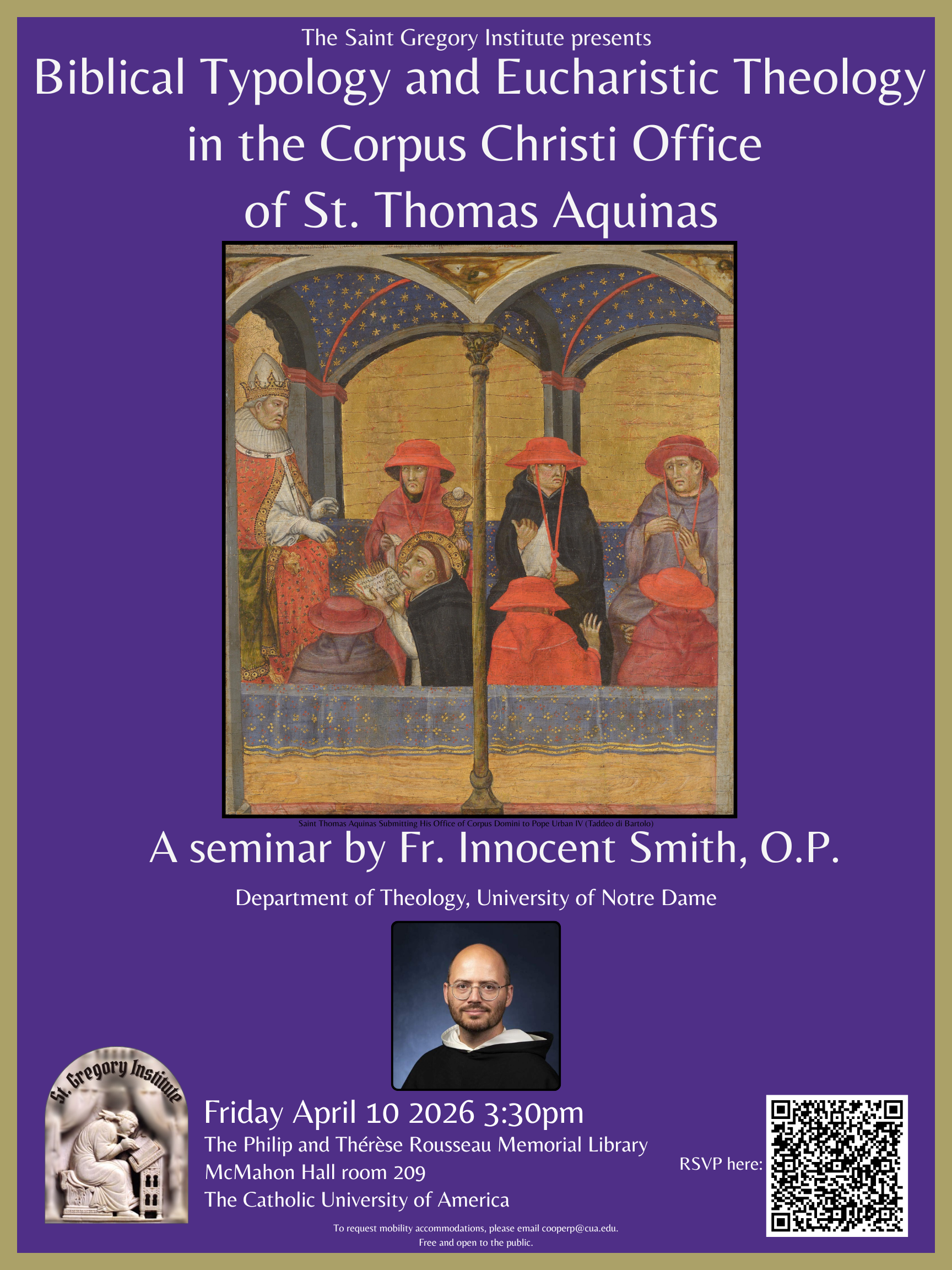
Really Dead Languages III - a linguistic odyssey of 8,000 miles and two millennia all from within McMahon Hall
Paul Cooper, Sarah Ferrario, and Lilla Kopár
For the third year in a row and in the deep of mid-winter, the lecture series entitled Really Dead Languages and their Epigraphy (RDL) enthralled and informed scores of attendees. Each year’s RDL is a three-day workshop of intensive one-hour introductions to a wide variety of ancient and medieval languages and their writing systems organized by CUA’s Department of Ancient and Medieval Languages and Cultures. This year’s series ran during the hyperborean final days of January when the outside world was encased in 'snowcrete.' Inside McMahon Hall however, a shared enthusiasm for lingual obscurity kept ice at bay.
The 2026 RDL began with talks on historical linguistics (Dr. Lilla Kopár) and the Canaano-Akkadian tablets of the Amarna Letters (Dr. Andrew Gross). When obscurity knocks, RDL opens the door with a wide welcome!
Day two featured our first guest speaker, Dr. Adam Bremer-McCollum (Harvard University). He took us to Mongolia to learn about Old Turkic and Uyghur. Dr. Andrew Litke brought us back westwards with his lecture on the Aramaic of the Dead Sea Scrolls.
Day three burst with guest speakers: Dr. Andrew Merritt (Georgetown University) explained Avestan (the language of early Zoroastrian texts); Dr. Julia Hintlian (PhD, Harvard University) told us about Classical Armenian; former CUA professor Dr. Joan Grimbert shared her love of Old French and Chrétien de Troyes; and the finale was the return of RDL II’s Mayan experts, Drs. Frauke Sachse (Dumbarton Oaks) and Joanne Baron (Princeton University Art Museum), who this year unpicked the complex story of and within the Popol Vuh. During Saturday’s lunch break attendees visited an exhibition of Classical Armenian manuscripts and other artefacts in the collection of the Institute of Christian Oriental Research (ICOR).
Dr. Grimbert expressed her appreciation for the series thus, ‘It’s wonderful that you have been able both to identify scholars who are immersed in so many ancient languages and to attract such a large audience.’ Dr. Grimbert is correct, the audience comprised undergraduate and graduate students, alumni, faculty from CUA and area universities, and members of the general public; the venue was full for each talk.
The speakers enjoyed RDL III as much as the audience. Still thrilled a few days after the event, Dr. Sachse wrote ‘Really Dead Languages III was a great success and as much fun as last year. Congratulations! You have created something really wonderful with this conference and I hope that it can continue.’
We feel compelled to continue - if only because there are a lot more really dead languages to be showcased. We appreciate the generous support of the College of Arts and Sciences and the enthusiasm of each speaker without which we couldn’t have put on RDL III let alone already start planning RDL IV.
We shall let the last word on RDL III go to a member of the next generation of scholars, CUA freshman, Jean-Luc Lapierre, ‘Really Dead Languages deepened my understanding of the historical background of ancient languages and the socio-cultural milieus in which they were practiced. The series enriched my appreciation for how the study of archaic languages sharpens our understanding of the ancient world and advances knowledge through modern scholarship.’
Mr. Lapierre's gracious summary of our three-day linguistic voyage deserves to be etched in stone and buried for three millennia for the RDLers of the far future to unearth and geek out on.
Jeanne-Nicole Mellon Saint-Laurent to give the 2026 Voice of the Syriacs Lecture
On 16 February 2026, Jeanne-Nicole Mellon Saint-Laurent, Associate Professor of Historical Theology, Marquette University, will give the 2026 Voice of the Syriacs Lecture, Sacred Taste in the Syriac Tradition.
Where: McMahon Hall room 200 (on the campus of the Catholic University of America)
When: Monday, February 16 at 5:30 pm with a reception to follow the lecture.
This lecture is free and open to the public.
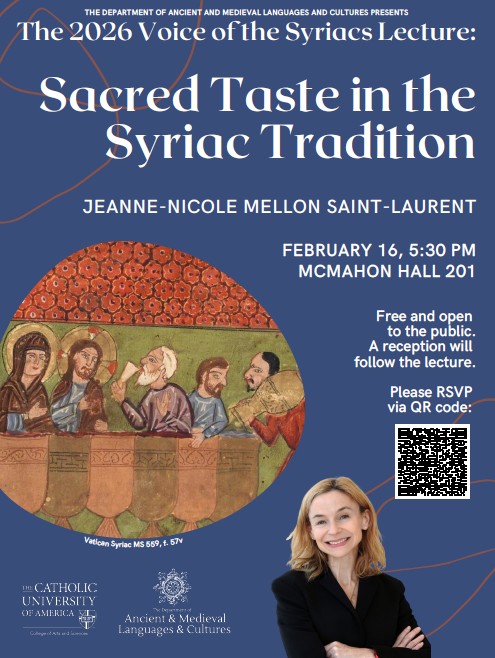
The lecture is presented by the generous support of an anonymous donor.
For disability accommodations, please contact Paul Cooper ([email protected]).
RSVP here.
Really Dead Languages returns for a third year!
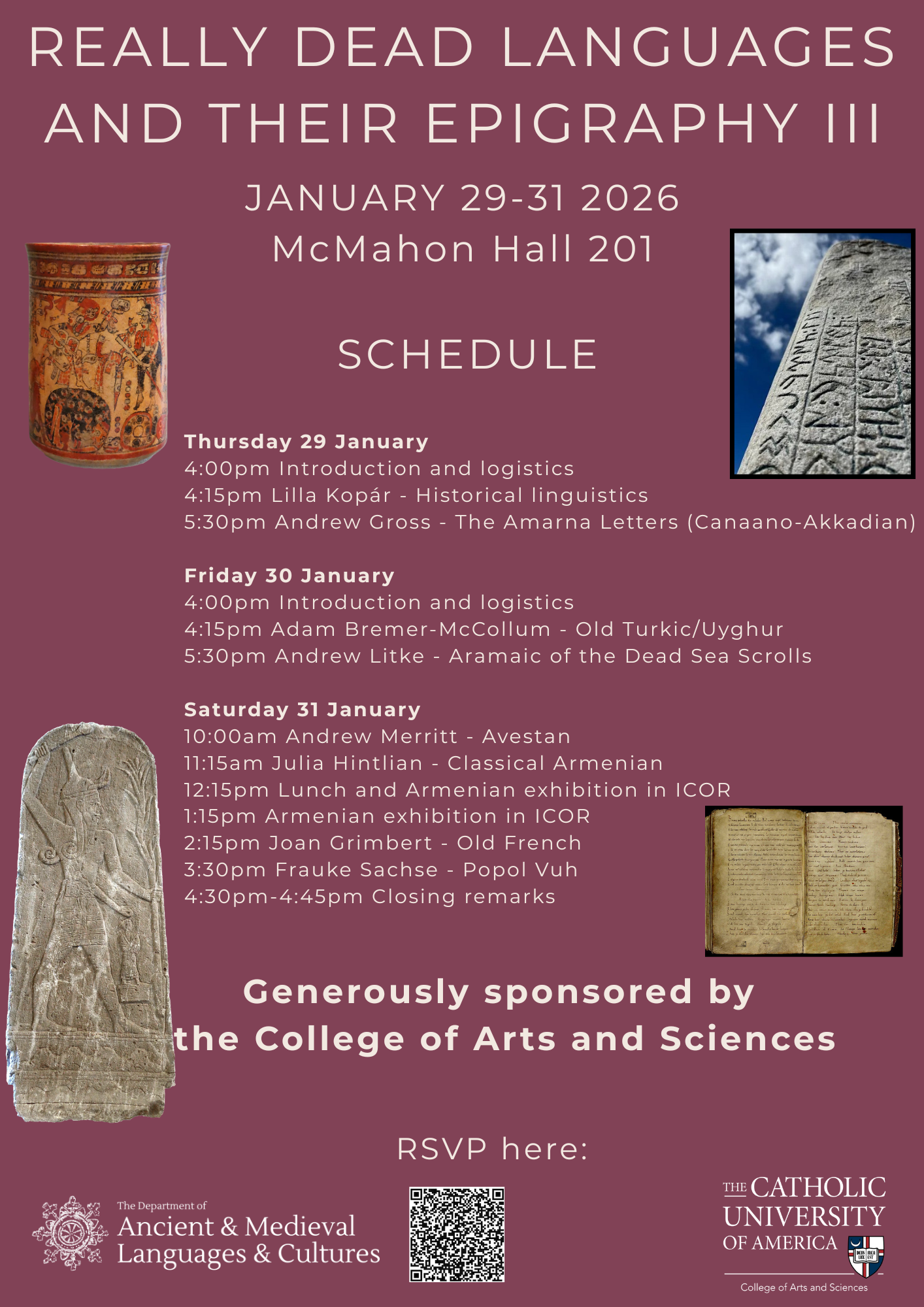
Can we have one more seminar before the end of 2025? Yes, you can.
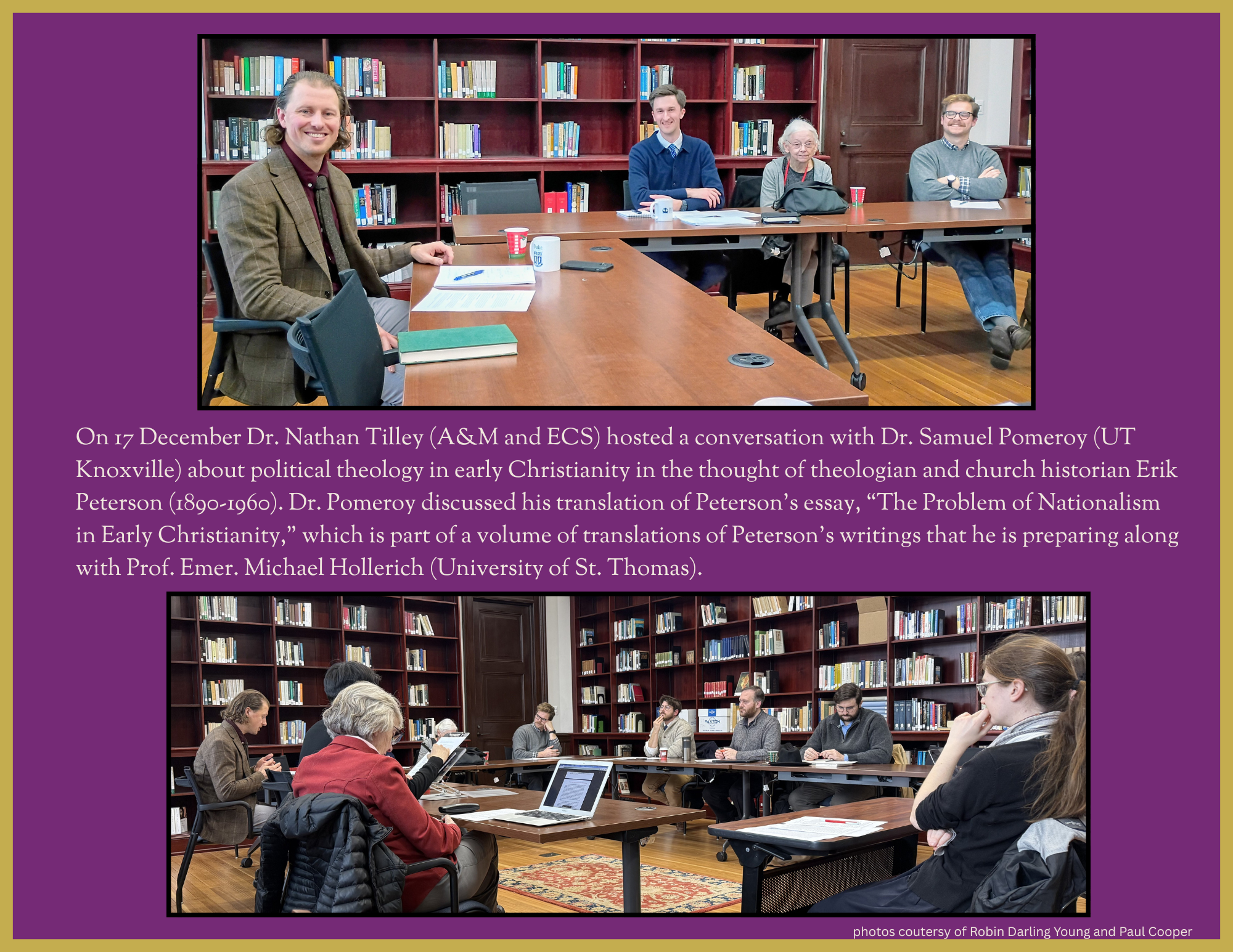
On 17 December twenty faculty and students from Ancient and Medieval, Early Christian Studies, Philosophy, and Theology and Religious Studies met to discuss political theology in early Christianity in the thought of theologian and church historian Erik Peterson (1890-1960) with Dr. Samuel Pomeroy, University of Tennessee Knoxville. Dr. Pomeroy is preparing a volume of translations of Peterson’s writings along with Prof.Emer. Michael Hollerich (University of St. Thomas).
What a very special guest lecture that was!
Tim Whitmarsh, Regius Professor of Greek (University of Cambridge), delivered a fascinating lecture on Monday 1 December. His talk on The Greatest Stories Ever Told: Pagan Epic and Christian Byzantium even referenced David Bowie!
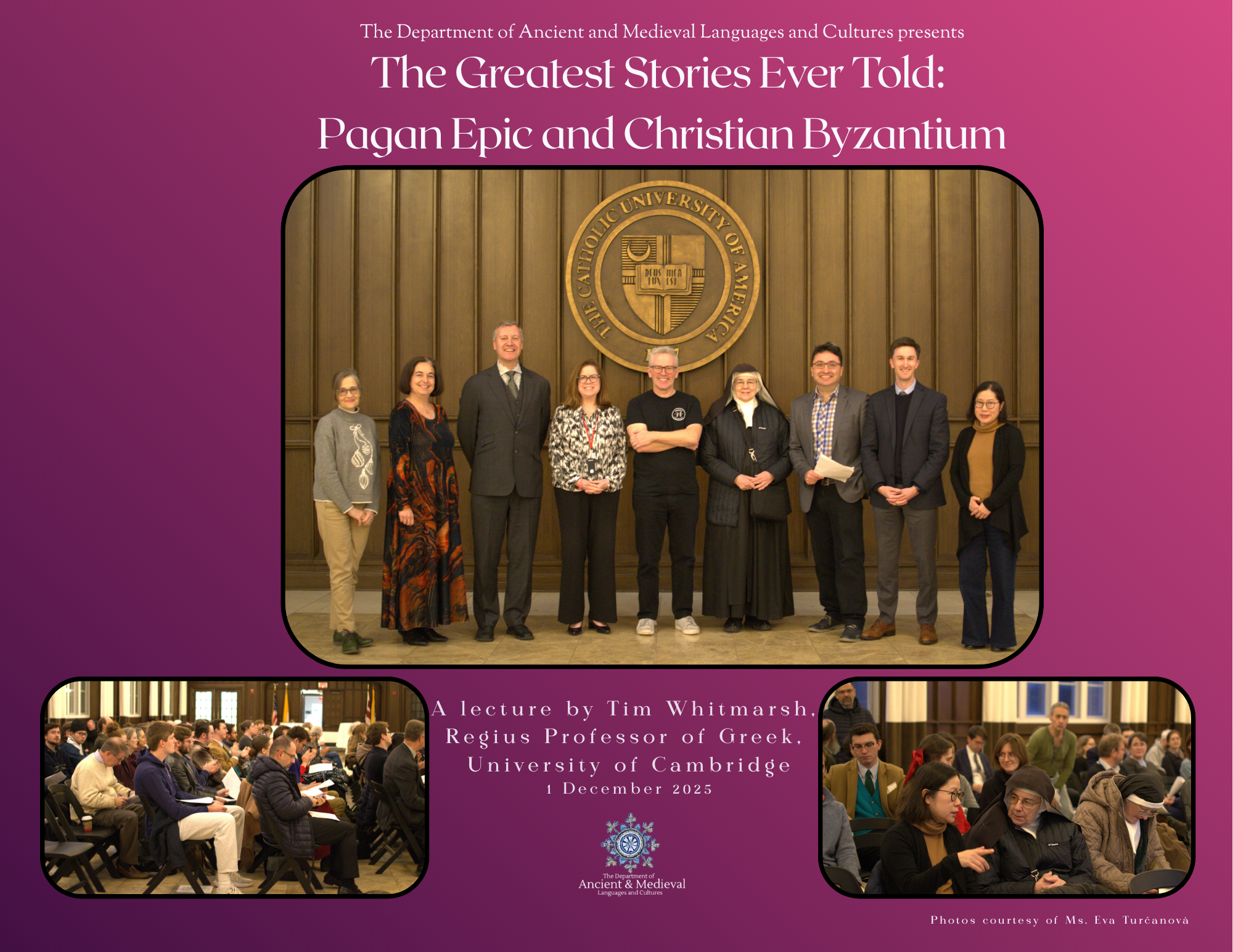
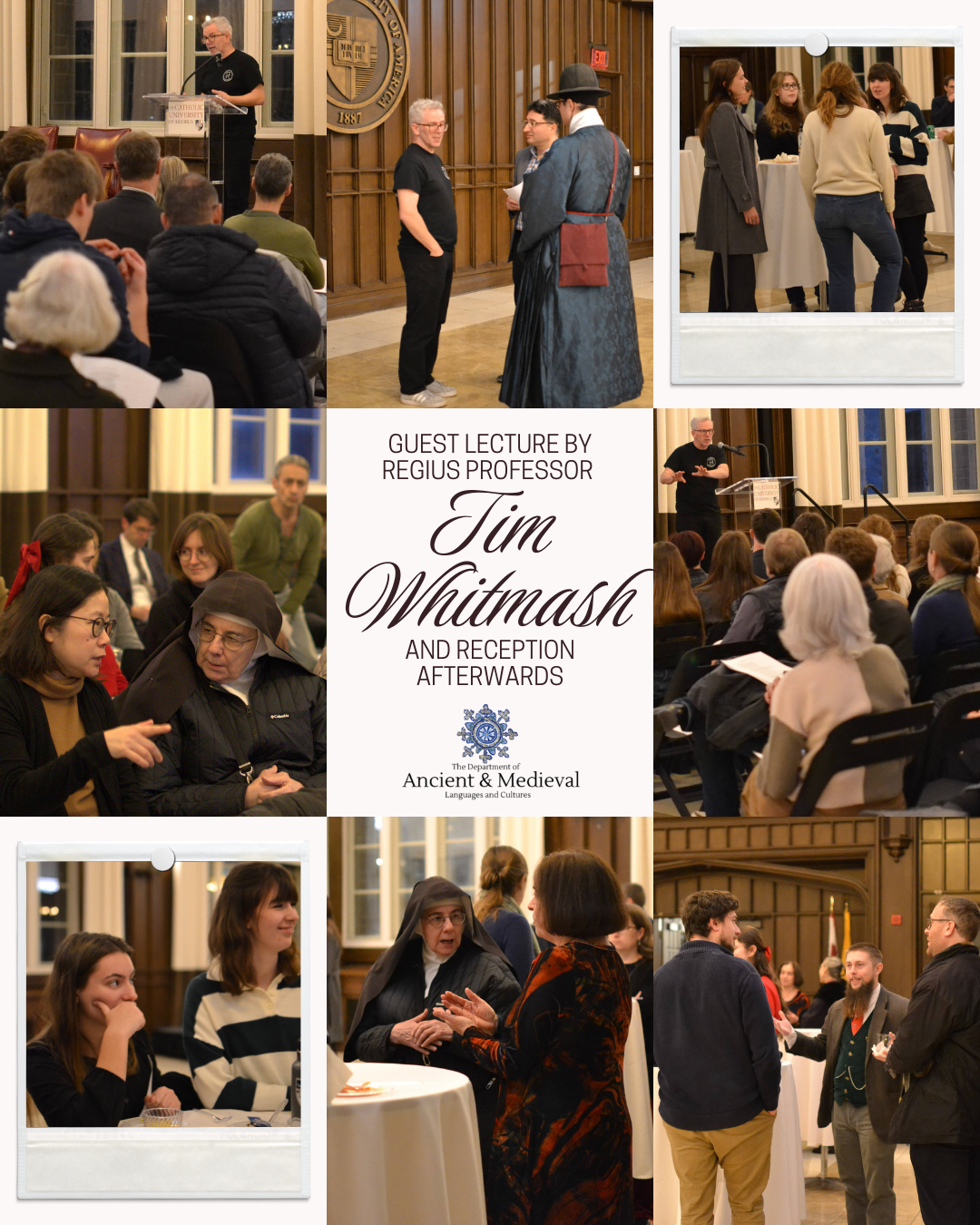
Consider donating to Ancient and Medieval Languages and Cultures on Giving Tuesday (2 December 2025)
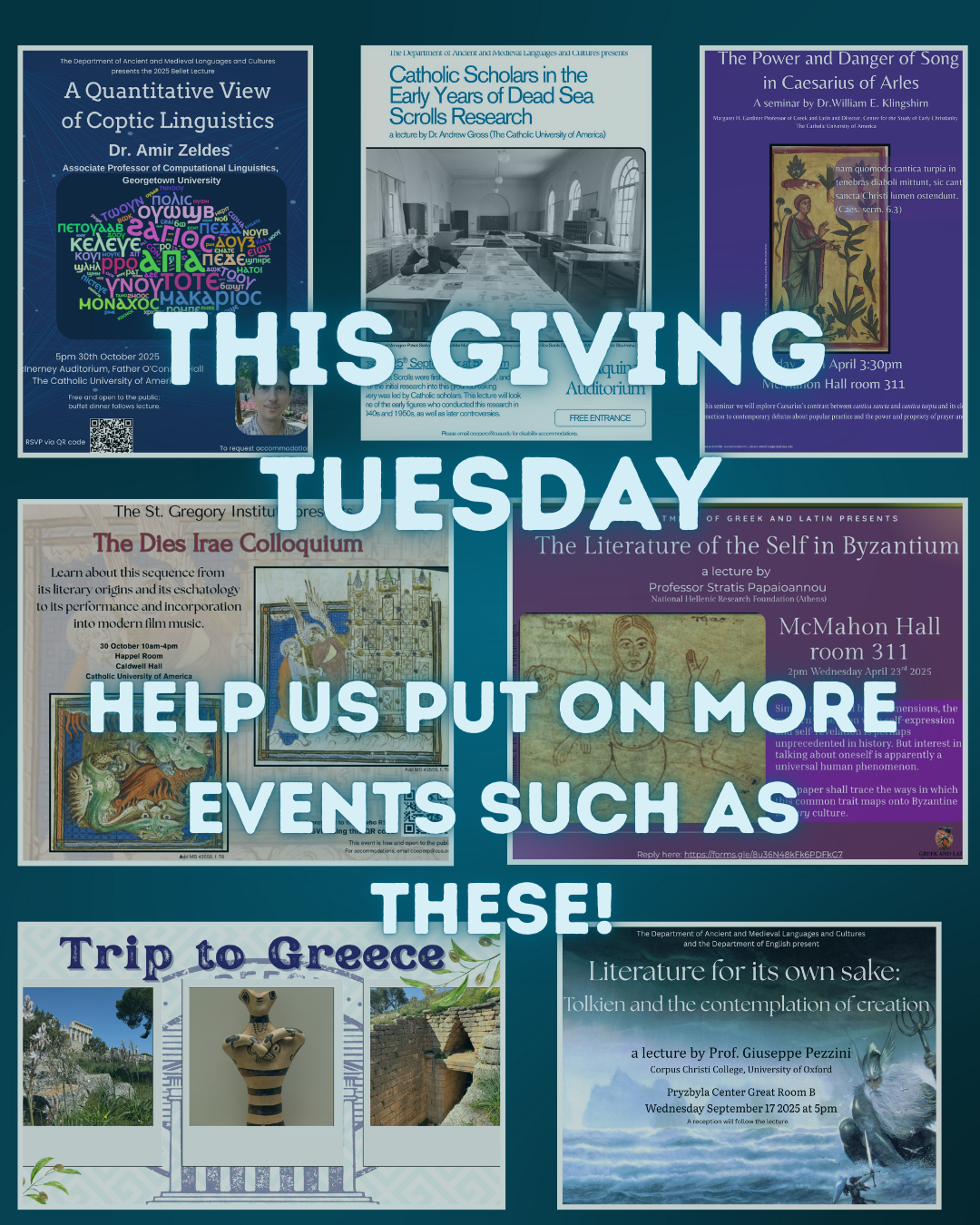
Very special guest lecture 1 December 2025
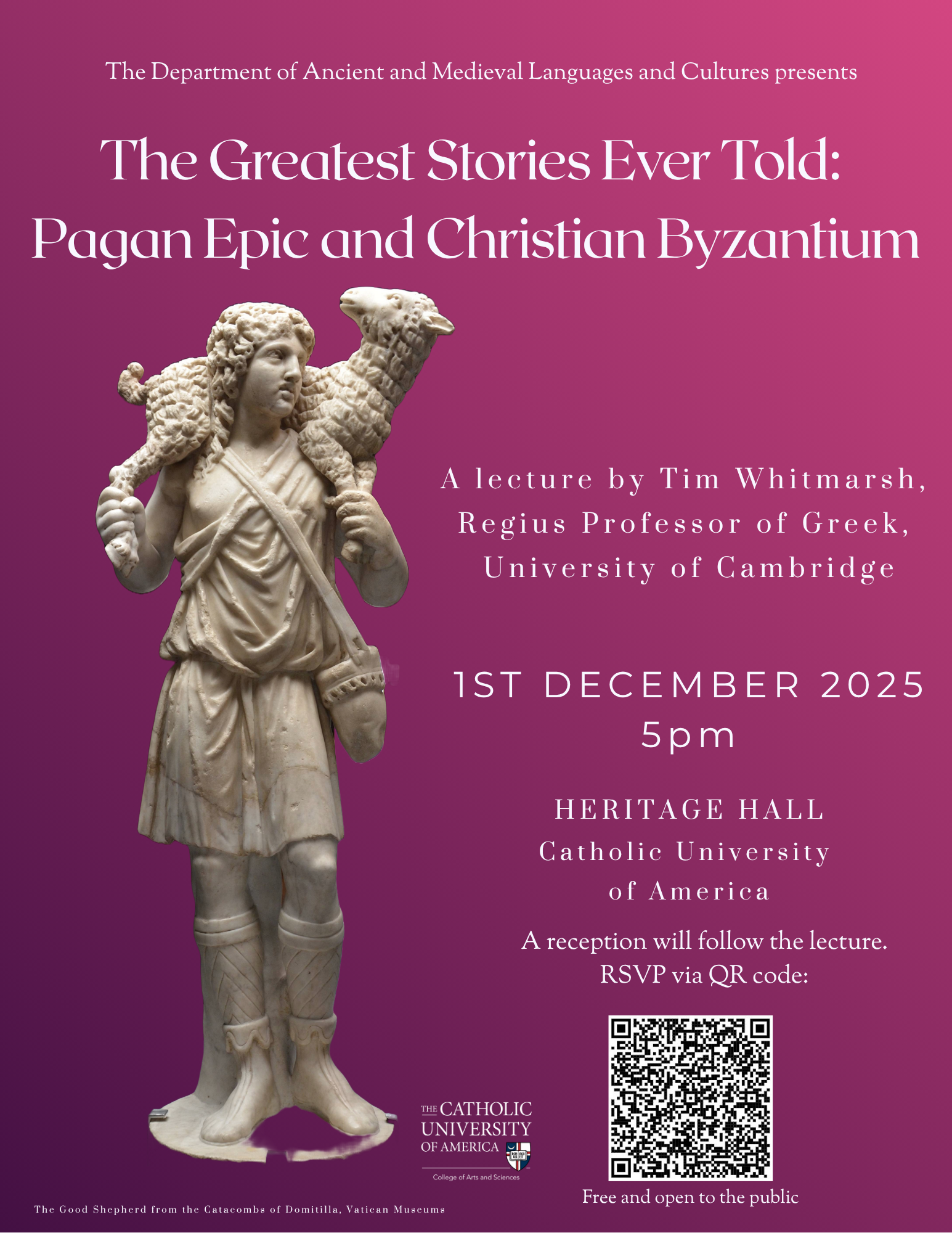
We are thrilled to welcome the Regius Professor of Greek (University of Cambridge), Dr. Tim Whitmarsh. Dr. Whitmarsh will give a lectured entitled The Greatest Stories Ever Told: Pagan Epic and Christian Byzantium.
Abstract: The fifth century CE is the era of classical antiquity from which we have the most surviving poetry. Why is this? What was it about this most theologically and morally decadent of pagan poetic forms that appealed to late antique Christians? This paper explores the cultural and psychological forces that allowed for a major renaissance of a literary form that had once been seen as the vehicle for all that was wrong with pagan culture.
Please use the following link to let us know if you are able to attend: https://forms.gle/jZk54pHtoEF7Gwjn9
Paul Davis, Semitics' most recent Ph.D!
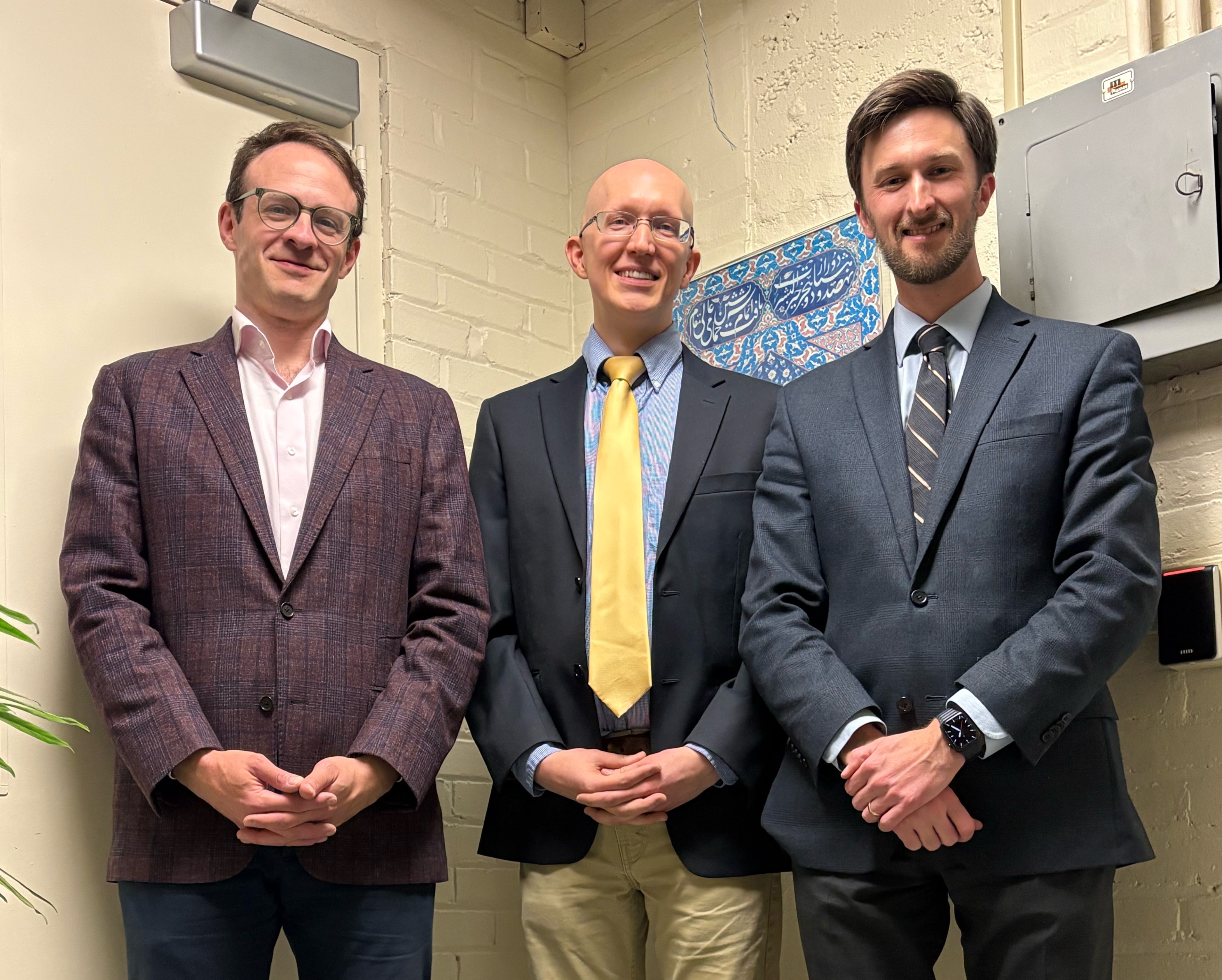
On Thursday, November 20, Paul Davis defended his dissertation for the PhD in Semitics. His dissertation is titled “The Social Function of Christian-Muslim Disputation Texts from the Early Abbasid Period.” Paul’s committee included Dr. Nathan Tilley (A&M) as director and Dr. Shawqi Talia (A&M) and Dr. Lev Weitz (History) as readers. Congratulations, Paul!
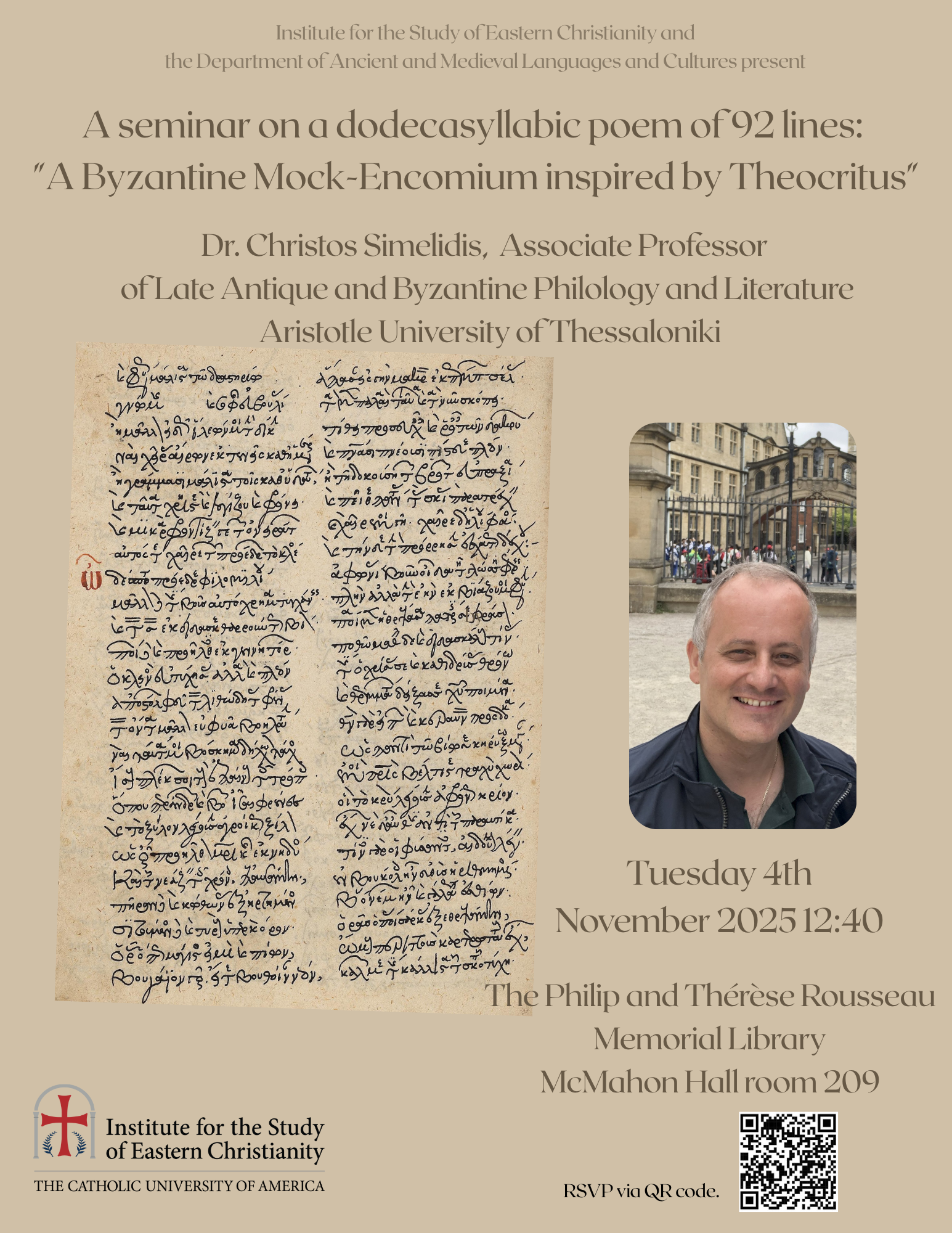
Guest graduate student seminar 4 November 2025
Abstract
Michael the Grammarian, an eleventh-century teacher, composed a witty and biting satire against a bishop of Philomelion, a man who, according to the poem, gained his office not through merit but by providing girlfriends for his superior, the metropolitan of Amorion. My paper will argue that this text works best when read as a mock-encomium: a parody of the traditional praise speech, in which the bishop himself ironically “celebrates” his own lowly origins, incompetence, and vices. Michael’s model here seems to be the satirical spirit of Lucian, especially works like the Parasite and the Teacher of Rhetoric. At the same time, the poem draws inspiration from Theocritus’ eleventh idyll, the Cyclops Polyphemus’ comic love song for the sea-nymph Galateia, which blends in self-praise that Michael may have read as an ironic self-encomium. The poem also shows rare eleventh-century familiarity with Euripides’ Cyclops. In this presentation, I will explore how Michael’s poem combines satire and classical models to create a unique work that sheds light on the literary and educational culture of his time.
The seminar starts at 12:40 in the Philip and Thérèse Rousseau Memorial Library
(McMahon Hall room 209). A lunch will be provided before the lecture to those who RSVP.
Please rsvp here.
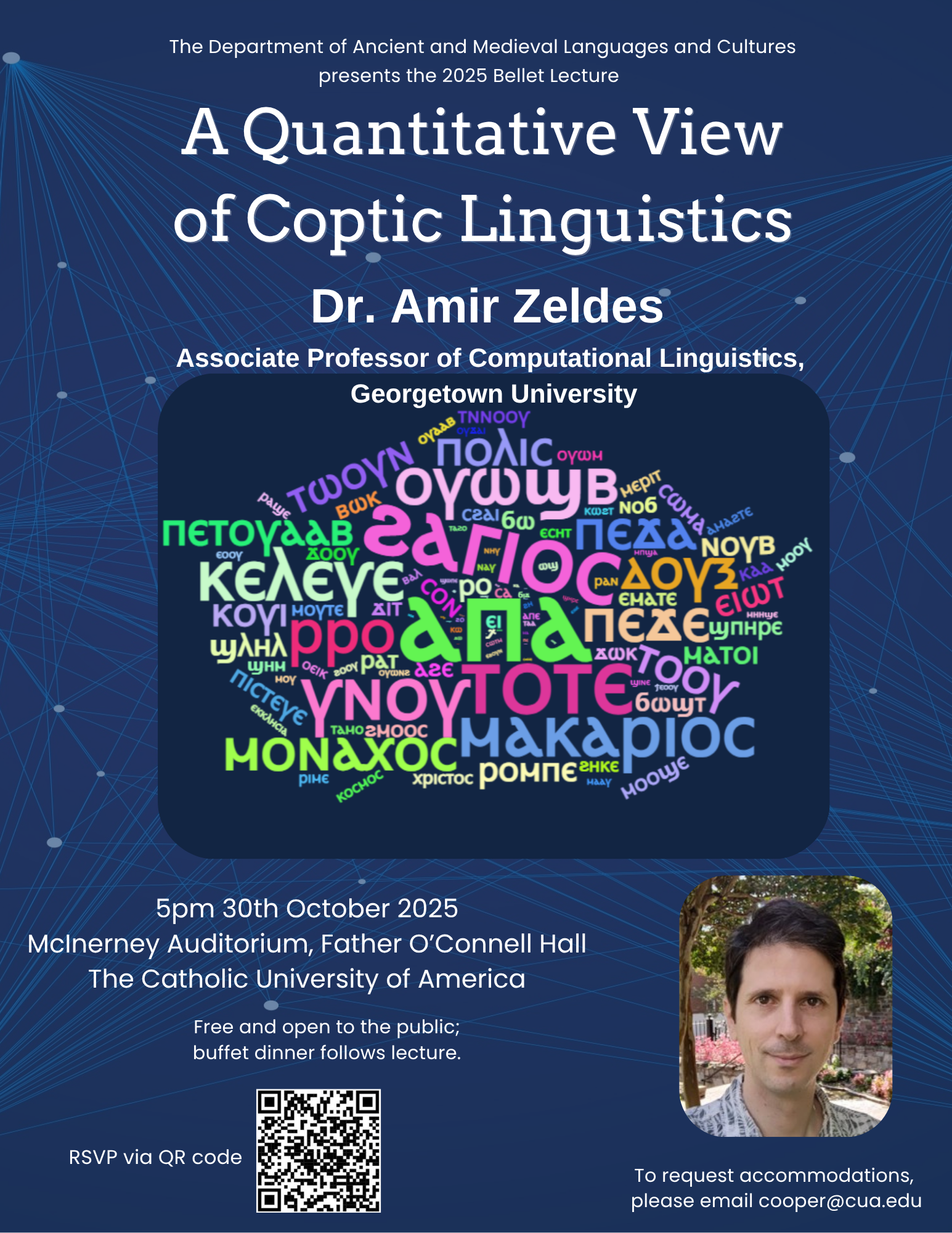
The 2025 Bellet Lecture, A Quantitative View of Coptic Linguistics, 30 October 2025
Speaker: Dr. Amir Zeldes Associate Professor of Computational Linguistics, Georgetown University
Abstract
The past ten years have seen a dramatic growth in the digital resources available for the study of the Coptic language. From a very low resource language with few openly searchable corpora and no dedicated analysis tools, we now have sizable collections of works from different periods and dialects, online lexicographical resources and natural language processing tools, many of which have been developed within the Coptic Scriptorium project (https://copticscriptorium.org/). In this talk, I will give an overview of some of the resources, workflows and standards that the project has established, and then present a series of case studies illustrating how we can use quantitative, machine readable data to study Coptic language and literature in new ways. The studies will cover aspects of constructivist approaches to Sahidic Coptic grammatical alternations, applications to dialectology focusing on comparisons with Bohairic Coptic and Greco-Coptic language contact, as well as the potential for typological studies connecting Coptic to other languages in the Afro-Asiatic family and beyond.
A buffet dinner will follow the lecture. Please RSVP here.
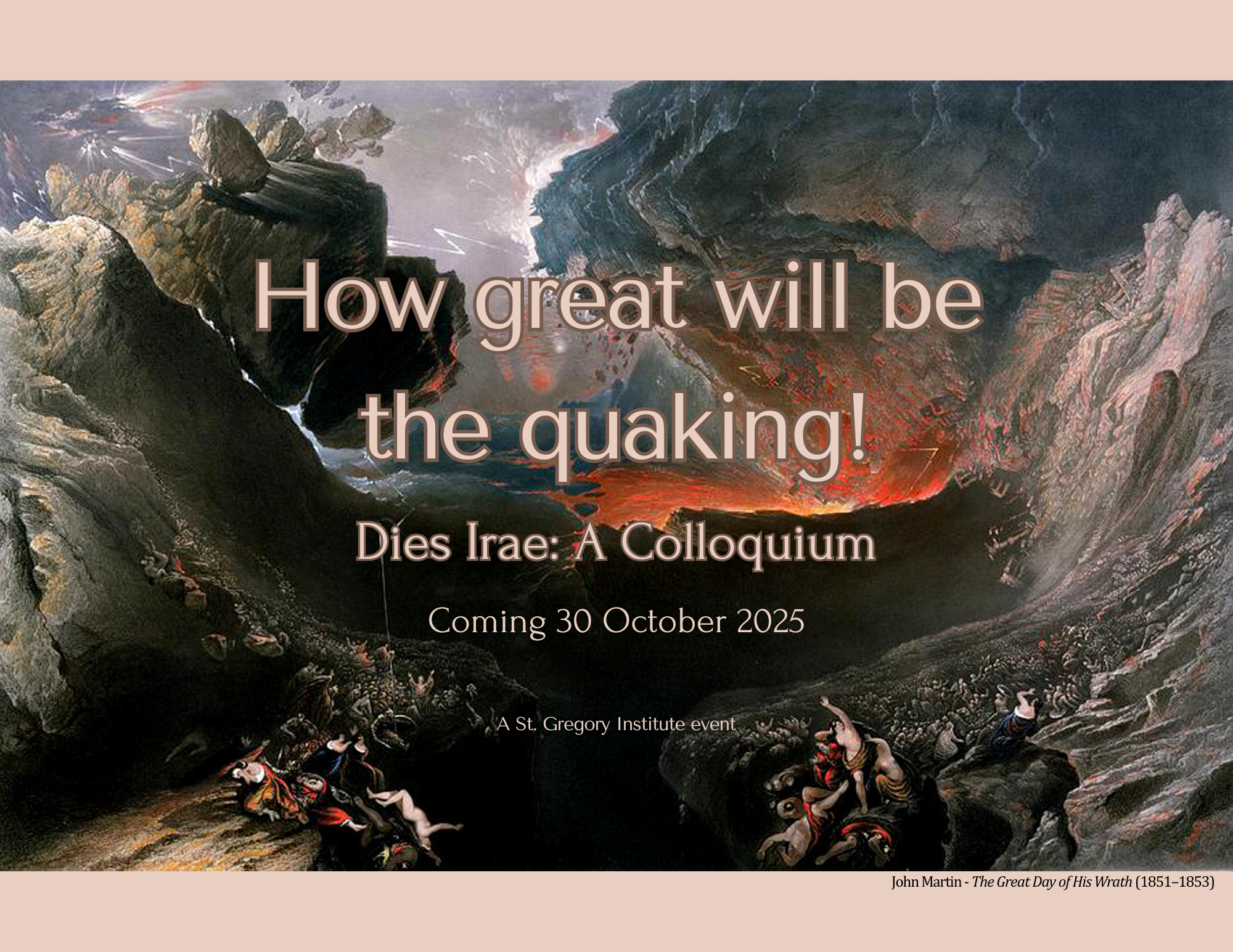
Colloquium on the Dies Irae, 30 October 2025
The St. Gregory Institute invites you to join a colloquium on the Dies Irae. You will learn so much about this sequence from its literary origins and its eschatology to its performance and incorporation into modern film music.
Program of the day
All sessions in the Happel Room of Caldwell Hall unless stated.
10:00 Msgr. Andrew Wadsworth: Introduction to the Dies Irae
10:30 Dr. Charles Cole: directed signing of the Dies Irae
11:00 Dr. Michael Root: "The Eschatology of the Dies Irae: Judgment, Mercy, and Grace"
11:45 Dr. William McCarthy: “…cum Sibylla”: Unpacking the Source(s) and Artistry of the Vexing Allusion
1:00 Lunch in Garvey Hall
2:00 Dr. Martin Baker: improvisation on the Dies Irae, Basilica, Upper Church
2:30 Dr. Andrew Simpson: The Reception of the Dies Irae
3:30 Q&A
4:00 End of the Colloquium
Medieval Banquet, 8 October 2025
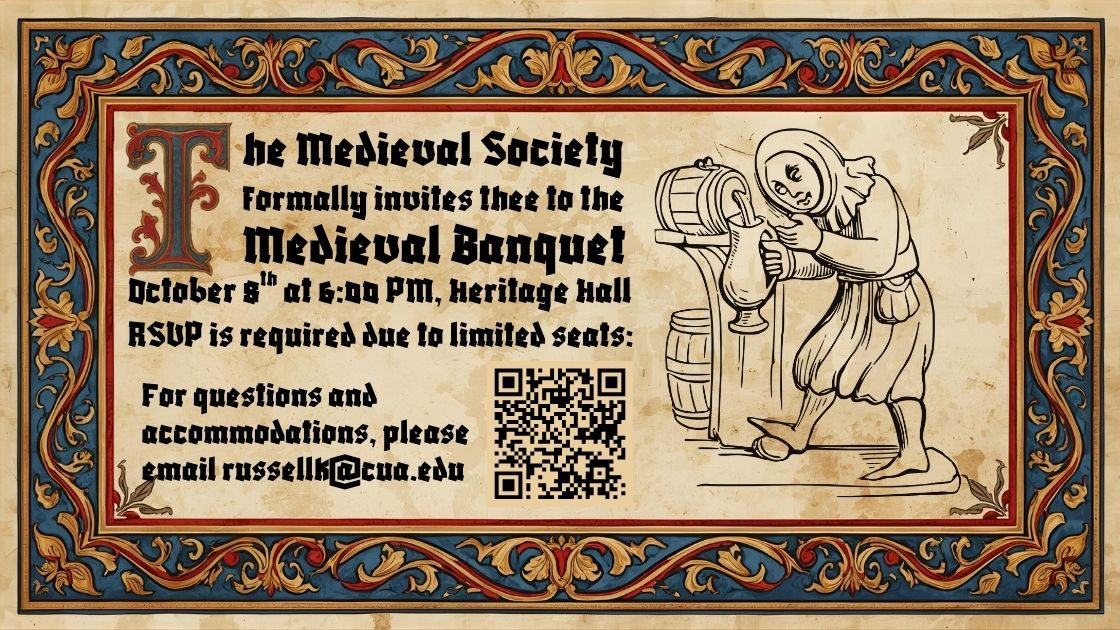
Sign up for the Medieval Banquet on Wednesday, October 8, at 6 pm in Heritage Hall. Medieval dishes will be served, and there will be much rejoicing!
Esteemed Syriac scholar visits the Semitics Library
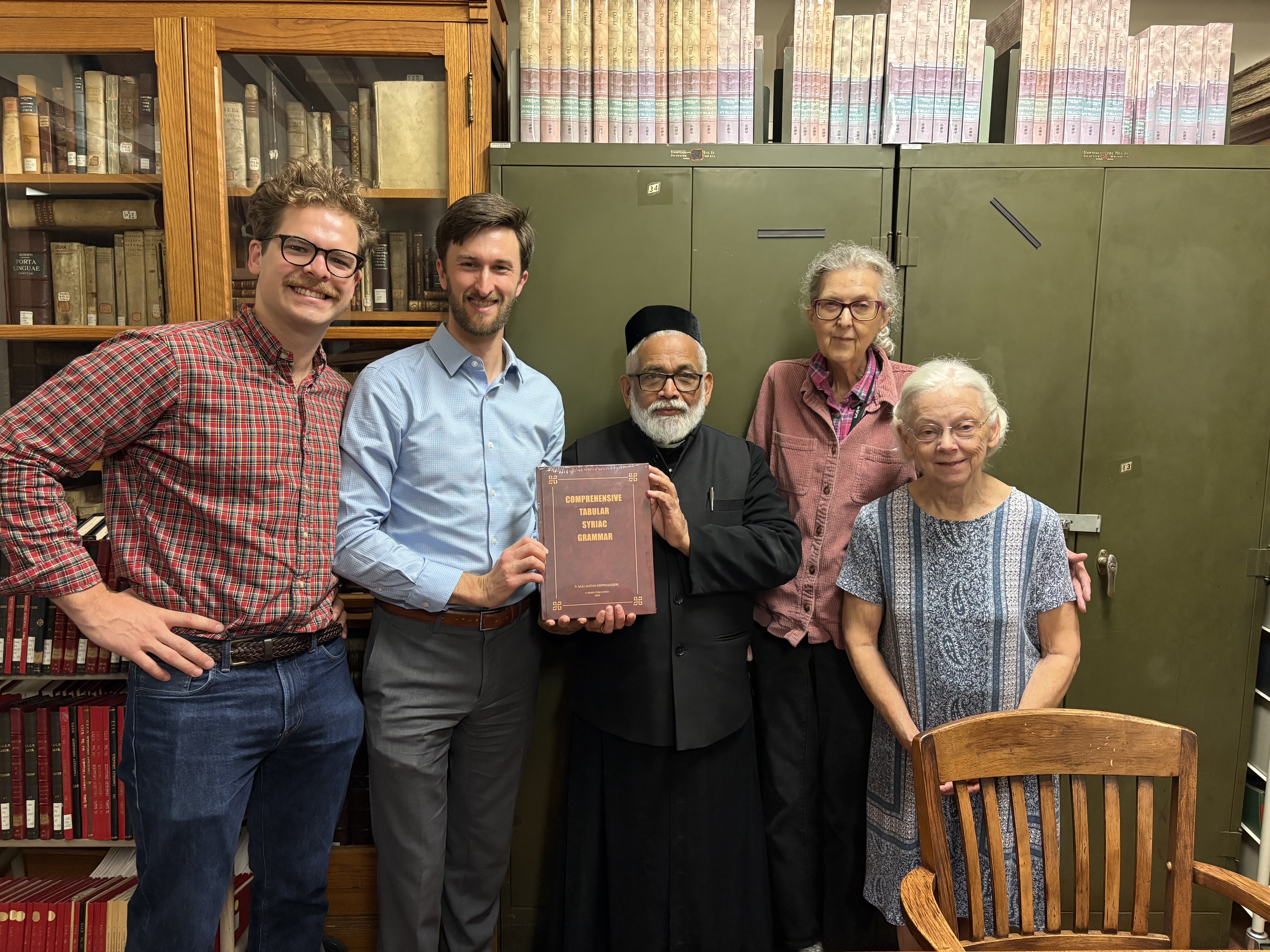 On Thursday, September 25, the Institute of Christian Oriental Research (ICOR) welcomed Rev. Fr. Saju K. Mathai Keeppanasseril to the Semitics Library. Fr. Saju is the director of the MIMRO Syriac Institute based in Kerala, India. Fr. Saju presented a copy of his recently published Tabular Syriac Grammar to ICOR and met with faculty and students from the department.
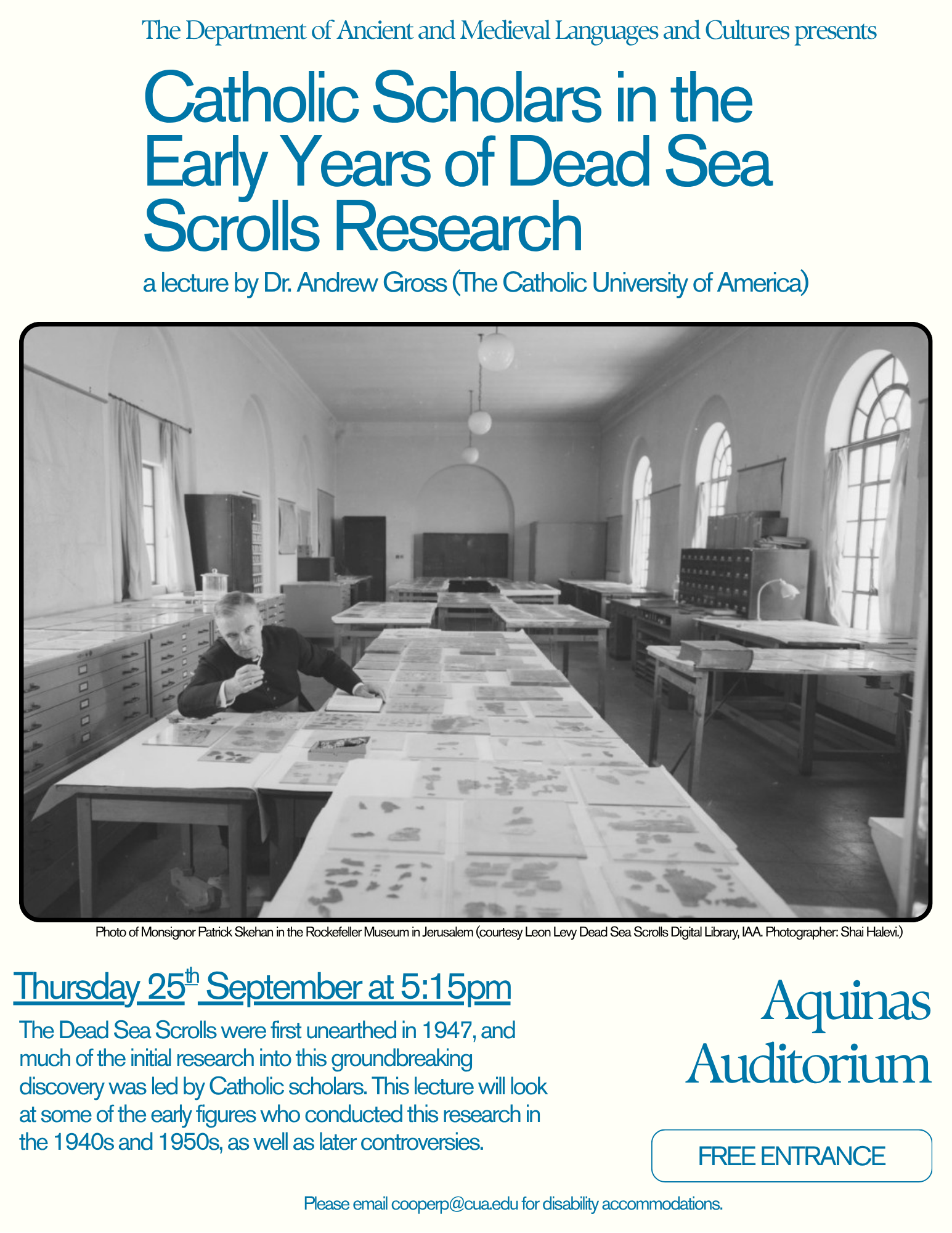
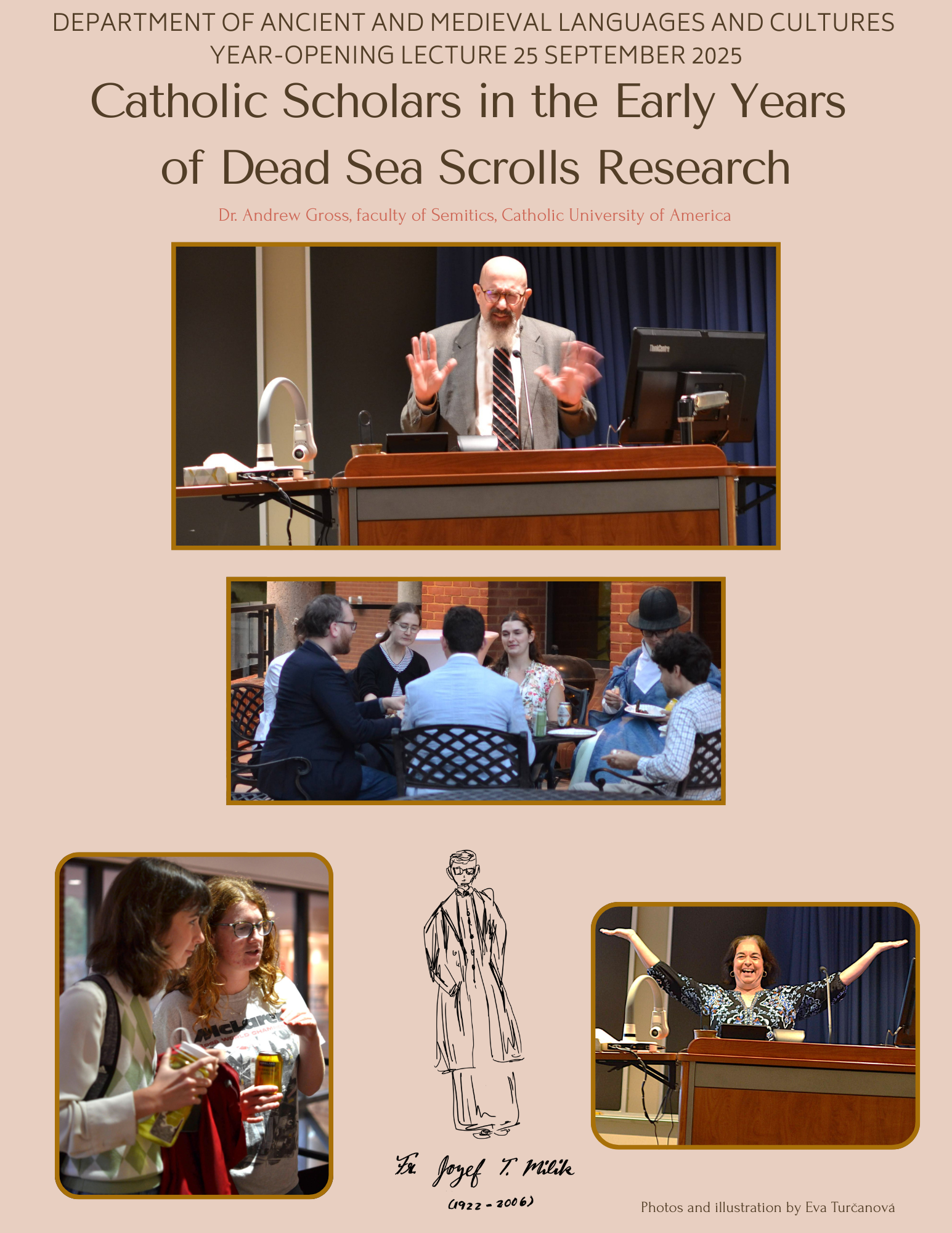
The 2025 year-opening lecture, Catholic Scholars in the Early Years of Dead Sea Scrolls Research, 25 September 2025
Speaker: Dr. Andrew Gross, faculty of Semitics, Department of Ancient and Medieval Languages and Cultures, Catholic University of America.
Dr. Nathan Tilley attends World Syriac Conference of the St. Ephrem Ecumenical Research Institute (SEERI) in Kottayam, India
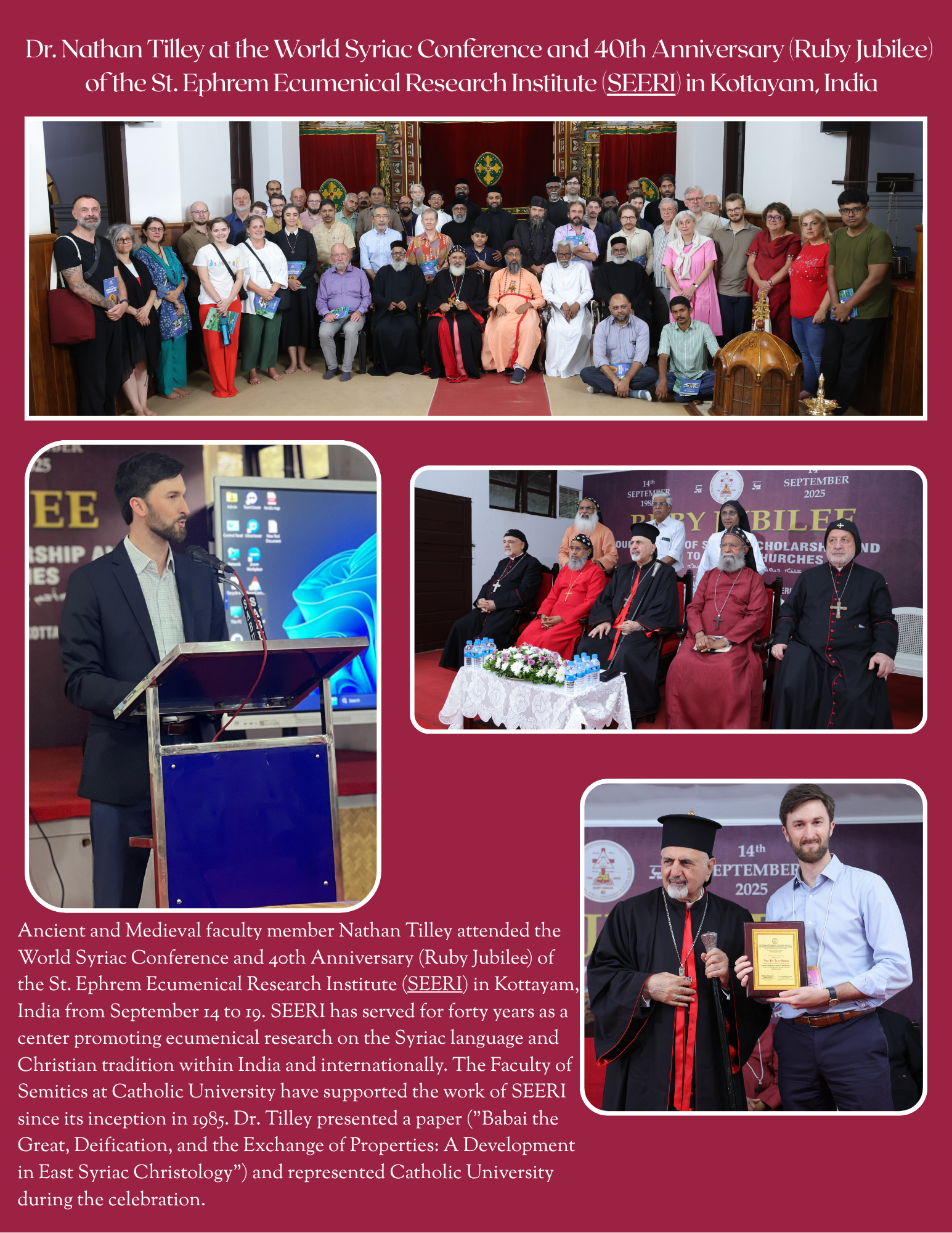
Faculty member Nathan Tilley attended the World Syriac Conference and 40th Anniversary (Ruby Jubilee) of the St. Ephrem Ecumenical Research Institute (SEERI) in Kottayam, India from September 14 to 19. SEERI has served for forty years as a center promoting ecumenical research on the Syriac language and Christian tradition within India and internationally. The Faculty of Semitics at Catholic University have supported the work of SEERI since its inception in 1985. Dr. Tilley presented a paper ("Babai the Great, Deification, and the Exchange of Properties: A Development in East Syriac Christology”) and represented Catholic University during the celebration.
Guest lecture, 17 September 2025
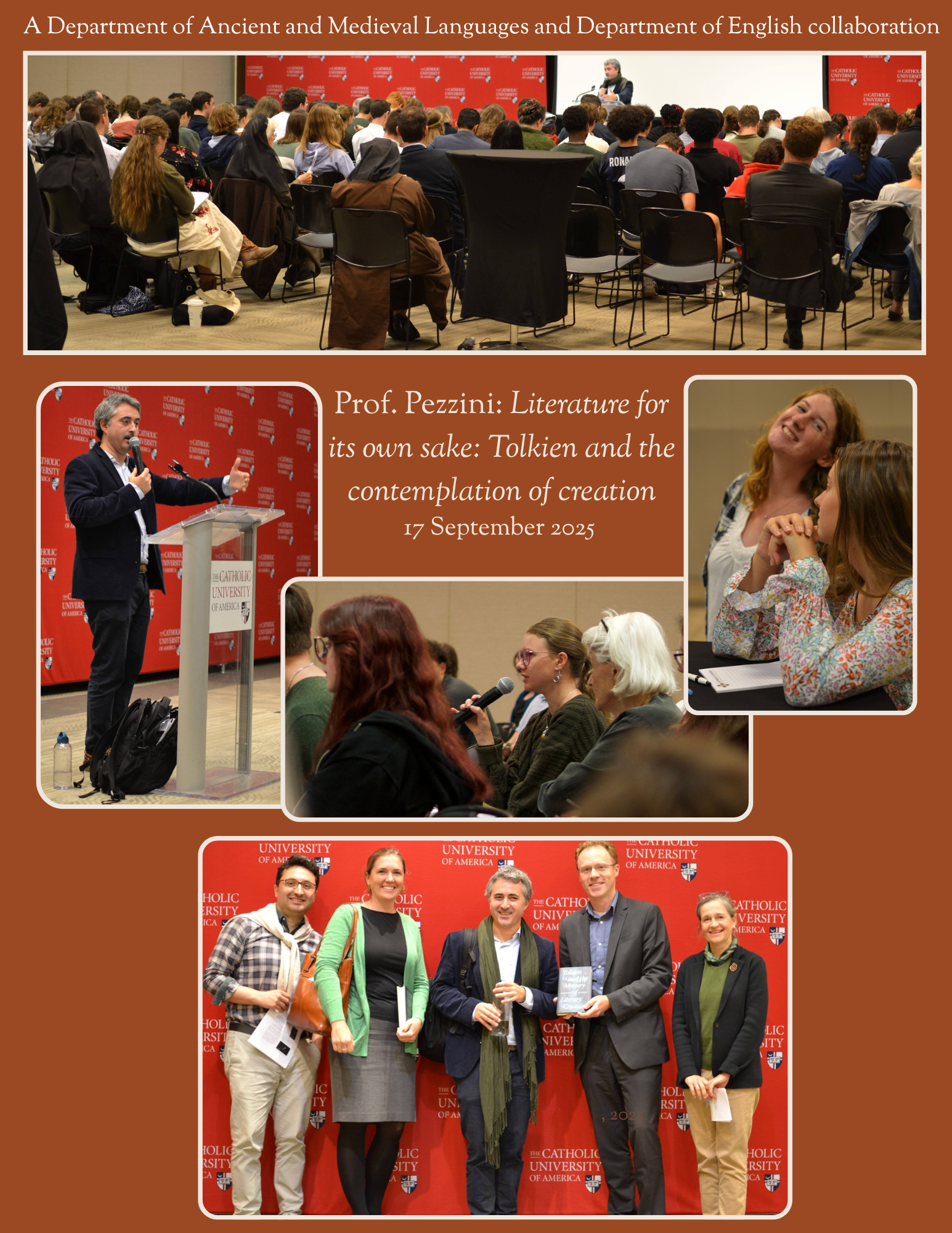
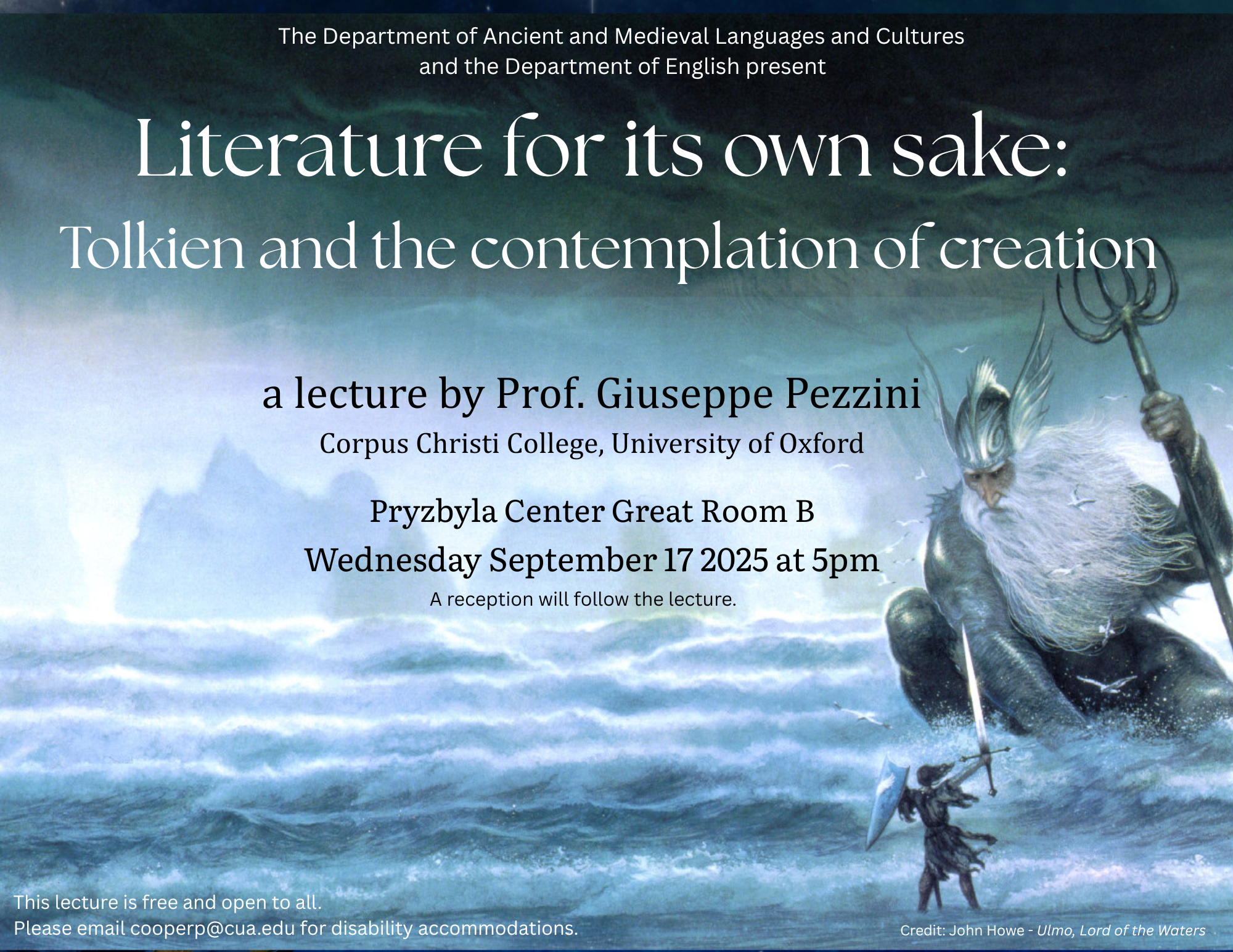
The Department of Ancient and Medieval Languages collaborated with the Department of English to put on a guest lecture, Literature for its own sake: Tolkien and the contemplation of creation, given by Professor Giuseppe Pezzini (Corpus Christi College, University of Oxford).
Redefining Classics 2025
The Department of Greek and Latin participated in the 2025 Redefining Classics conference by co-organizing an exhibition of Dr. Michele Valerie Ronnick's installation 14 Black Classicists.
Really Dead Languages is back and deader than ever!
Join us for any or all of four workshop sessions offering introductions to ancient and medieval languages and their epigraphy! No prior knowledge is required; attendance is open to the public and is completely free.
Our speakers will equip you with a basic understanding of each language (and its script)--enough knowledge to recognize these languages when visiting a museum, or to be the star philologist of your pub trivia team.
Thursday 6 Feb 5:30pm - The Celtic languages
Friday 7 Feb 4pm - Mayan hieroglyphs
Friday 7 Feb 5:30pm - Tour of Semitics/Institute of Christian Oriental Research collections
Saturday 8 Feb 10am - Sanskrit
Saturday 8 Feb 11:15am - Phoenician
Saturday 8 Feb 12:30pm - lunch at Garvey Hall
Saturday 8 Feb 1:15pm - Tour of Semitics/Institute of Christian Oriental Research collections
Saturday 8 Feb 2pm - Iron Age Hebrew funerary inscriptions
Saturday 8 Feb 3:15pm - Runes: There and Back Again
Saturday 8 Feb 4:15pm - closing discussion
Departmental alumnus produces a Latin reader's edition of St. Augustine's Confessions
Emmaus Academic Press has published a Latin reader's edition of St. Augustine's Confessions by CUA Greek and Latin alumnus, Kevin Bergdorf (Certificate in Greek and Latin, August 2022).
Departmental alumnus publishes previously untranslated canon law Latin text
CUA Greek and Latin alumnus Dr. Lionel Yaceczko translated a previously untranslated Latin text of the Syllabus, part of defence documents submitted during the Mortara case (1858). Dr. Yaceczko's translation appears in the CUA Press book The Mortara Case and Thomas Aquinas's Defense of Jewish Parental Authority: With Original Documents from the Mortara Case: Pro-memoria, Syllabus, Brevi cenni, published in February 2025.
Faculty member receives award for excellence in teaching
Professor William McCarthy, faculty member in the Department of Greek and Latin, received the Ingrid Merkel Award for Excellence in Teaching at a ceremony in Heritage Hall on Tuesday 3rd September 2024. The citation of Professor McCarthy's achievements that Dean Tom Smith read praised Professor McCarthy for '[modeling] the very essence of the human “desire to know”: his ability to connect ideas across time and space is fed by his remarkable memory for detail and sustained by his voracious curiosity.'
Research Associate alumnus honored for scientific achievements
Luigi M. De Luca (Maturita' Classica, Capece State College, Maglie, Lecce, Italy; Doctorate, Organic Chemistry, University of Pavia, Italy; M.A., Classics (Latin), University of Maryland, College Park; M.A., Greek, Catholic University; Ph.D., Greek and Latin, Catholic University), alumnus and Research Associate of the Department of Greek and Latin, has recently been inducted as a Fellow of the American Society for Nutrition Foundation, an honor conferred upon senior-level academics for professional contributions to the field of nutritional sciences (in this case, specifically Nutritional Biochemistry). Dr. De Luca's diverse academic skills and interests were also clearly represented in his 2019 dissertation for this department, which studied Basil of Caesarea’s botany, pharmacology, and nutrition.
Departmental alumna wins ACLS fellowship
Jocelyn (Rohrbach) Moore (B.A., Catholic University; M.A., Washington University in St. Louis; Ph.D., University of Virginia) has recently been awarded a 2023 ACLS Fellowship from the American Council of Learned Societies (ACLS) to finish her book, If the House Would Speak: The House in Greek Tragedy, during the 2023-24 academic year. "The ACLS Fellowship Program supports exceptional scholarship in the humanities and interpretive social sciences that has the potential to make significant contributions within and beyond the awardees’ fields."